Hulu’s Sci-Fi Comedy Future Man is a refreshing surprise

Original and fearless, it answers the question “What would happen if we mixed Terminator with Pineapple Express?”

Future Man is, without a doubt, the greatest janitor-centered time travel comedy of 2017. The concept is straightforward: Josh Futterman, a custodial worker at a biolab, lives with his parents and spends his free time playing Biotic Wars under the moniker Future Man. When he beats the game (the first person to do so), he discovers that it’s actually a recruitment/training simulation. Two future warriors straight out of an 80s B-movie materialize in his bedroom and tell him the Biotic Wars are real and he’s humanity’s savior.

Here it is: https://www.hulu.com/grid/future-man. It’s unfortunately only available with a Hulu account, but you need to be watching A Handmaid’s Tale anyway, so it shouldn’t be that painful.

The show takes a little time to get off the ground. The first couple of episodes are rough because it’s so clearly wish fulfillment — the loser with a dead-end job gets to hang out with Time Marines. As it becomes more and more clear that any easy tropes Future Man uses are there to be subverted, the narrative becomes more interesting. By episode 5, the rightness of the war against the Biotics is called into question, and what was a goofy, fun sci-fi romp becomes a goofy, fun, sci-fi romp filled with moral ambiguity and existential doubt. It’s an amazing turn — one minute you’re laughing at Rogenesque (Seth is a producer) dick jokes, and the next you’re asking what reality is. The skeleton of this show is a time-travel comedy, but it’s fleshed out with writing that trusts the audience, true character development, and really careful attention to plot.

Entertainment is the defining feature of each episode — every one is laugh-out-loud funny. This ranges from dumb, crude jokes (the instant the soldiers materialize in Josh’s bedroom, he’s masturbating) to extremely complex and rewarding long-arc humor — grizzled warrior Wolf discovers a hidden talent for cuisine and spends the rest of the show conflicted between his persona as a Michelin-level talent and a man who can rip someone’s head off with his bare hands.

Future Man actually shows how deeply crippling it is to grow up in a world where the only choice is to become a super soldier or die

The attention to character is a big part of what gives the show real substance. Tiger and Wolf are parodies of 80s action heroes, and they absolutely are everything you’d expect as a result: trained killers, strong, direct, and unversed in 21st century niceties. Unlike the 80s movies that inspired these two, Future Man actually shows how deeply crippling it is to grow up in a world where the only choice is become a super soldier or die. At one point, Josh attempts to kiss Tiger, and she almost throws up. She asks why he would want to put “ratholes” together (“What else would you call the hole you stuff rats into?”), revealing the deep intimacy issues created in a kill-or-be-killed world. In addition to a realistic portrayal of the dark side of being a badass future soldier, the show shepherds each of the leading characters through personal development. Josh becomes more dedicated, more confident, and more able to work towards his goals. Tiger becomes more willing to express emotions, and Wolf (in what is possibly the best episode of the series) moves from being an unquestioning grunt into pursuing personal fulfillment to the hilt. It’s a goofy comedy, but its serious attention to true human emotion keeps it from being only that.

[E]ach change they make in the past has unpredictable, upsetting, and permanent results

The time travel in Future Man is the most painstaking exploration of the concept to make it to any type of screen in the last few years. The central conflict involves going back in time to assassinate the inventor of the super serum that creates the genocidal Biotics. The show is mainly a catalogue of how the multiple attempts and failures of the main trio shred the timeline more and more irreparably. Actions have consequences, and that is such an important quality of good narrative. For example, the most disappointing thing about Doctor Who’s decline in the post-Tennant years is its creeping but inexorable movement away from time travel having rules. In Doctor Who, if something is broken beyond repair, the Doctor can literally just scream I’M THE DOCTOR, completely ignore all rules of internal narrative consistency, and change everything to suit him. The writers make no reference to previously unbreakable rules, to commonly accepted time travel tropes, or even a decent explanation of exactly what it is the Doctor is doing. The absolute lack of consequences has transformed Doctor Who from a show written with kids in mind to a kids’ show. Future Man is on the other end of the spectrum — each change they make in the past has unpredictable, upsetting, and permanent results (the funniest and most trivial of which is Josh accidentally making his parents name him “Joosh”). The explanations for how time travel works don’t necessarily make sense because time travel itself doesn’t make sense, but the writers never insult the audience with hand-waving — they stick to their internally-consistent guns and explore consequences rationally.

While the show doesn’t get its feet under it until about episode four, it is impressive once it gets going. The writers chose what they wanted this show to be with no consideration for who would want to follow, no focus-group simplification — they just went for it, and the resulting joy of creation translates into a palpable energy in every scene. The contrast at the center of the show is constantly stimulating — it’s very much a goofy bro sci-fi show, but it explores its morals and characters with the utmost seriousness. Even if this show had no other saving graces, the montage where Wolf falls in love with the 80s is, by itself, worth the Hulu subscription.

Wolfenstein: The New Colossus is all about one thing — killing Nazis

The newest entry in the anti-fascist franchise brings the fight to America


Wolfenstein: The New Colossus is about one thing — killing every lowdown, dirty Nazi you see. It really doesn’t need a plot — the momentum of that overwhelming prime directive is enough to carry the game. The gameplay is basic point-and-shoot, but the customizability of weapons loadouts lends engaging variety to the simplicity. The character-level plot is pretty fuzzy and choppy, but the creepy, believably-crafted alternate history setting is strong enough to power the overarching plot: Nazis won World War II, they’ve annexed the United States, and your job is to set off a revolution that will burn Nazism out of America forever.

This is somehow a controversial political stance in today’s America. I wasn’t in the market for a shooter, but I picked up this game because there was an alt-right backlash, an actual backlash, against this tweet: https://twitter.com/wolfenstein/status/916075551382585344. It’s a basic promotional tweet, but the phrase “Make America Nazi-Free Again” ruffled some feathers on the internet. This ridiculous outrage, plus Bethesda’s response to it (uh, guys — we thought the “Are Nazis Bad” question was settled 70 years ago) made me decide to pick up the game, in which I spent 20 hours Making America Nazi-Free Again.


Everyone rips off The Man in the High Castle


Nazism is one of the great universally agreed evils (or at least it was) in the world. The USA built its modern mythos off of our actions to help topple a genocidal maniac and our assistance to a war-ravaged Europe in the postwar years, but the world of Wolfenstein takes that from us. We didn’t win. We don’t get to claim we helped save the world — the Nazis get to claim they own it. The proofs of this throughout the game are so visceral — from a nuked and crumbling Manhattan to a prison-city New Orleans, with Nazi machines of war patrolling to keep undesirables in check. The destruction of a major metropolis and the systematic genocide of American citizens, the construction of concentration camps on American soil, the colonization of the United States by the Reich — all of it feels real, constructed out of the surreal yet solid plausibility of nightmares.


Nazi parades and prison cities


The plot really is just to kill all Nazis, to systematically eliminate high-ranking targets in order to advance the interests of the rebellion, but the world of The New Colossus gives more than enough weight to the story. The artistic interest in the game isn’t so much what you do, but where you’re doing it. The vision of an America complicit in the Reich is stomach-churning, and supplies all the narrative impetus necessary to get you through the game. It’s in the details, like when you go to a Nazi parade down the streets of a small American town and overhear a German soldier berating a fawning Klansman for his atrocious pronunciation of the German he’s learning. It’s in the reaction of the propagandized citizenry to who you are — you’re not B.J. Blazkowicz, Polish-American hero of the ill-fated World War II, you’re Terror-Billy, indiscriminate killer and scourge to all upstanding American citizens. It’s in the casual complicity of those American citizens who are powerful — stand with the Reich, and the Reich will stand with you.


Bullets, bullets, and more bullets


This being a Wolfenstein game, the solution to this problem is to find all the bullets you can and fire them as quickly as you can. The enjoyment of the actual weapons use was a welcome surprise here. Bethesda treads a careful line between simplicity and variety — the choices aren’t overwhelming, but the customizability of each weapon and the ability to dual-wield mixed types makes it easy to match your exact loadout to how you want to play. I went with a LaserKraftWerk in my left hand, and a fully-optimized shotgun in my right. The first is a one-shot kill laser gun that’s a little bit touchy to aim, and the second is, well, a shotgun. The laser cut through all the distant opponents and all the heavily armored ones, and the shotgun obliterated close enemies and took care of cleanup in case of my poor aim with the laser. One issue with the game is, if you want to really buy in to the mythos of Terror-Billy, you might want to play on an easier setting. I eventually got the hang of things, but I spent a good half of the game getting absolutely brutalized by grunt soldiers, which really didn’t fit with the idea of B.J. Blazkowicz as an unstoppable killing machine.

The game is not a must-play, but it’s fun as hell. If you’re craving a shooter, I strongly recommend picking this one up. The horror of its alternate reality is plausible enough to hit you in the pit of your stomach, the gunplay is fast and engaging, and the game is a good reminder that yes, Nazis always have and always will be a Very Bad Thing.

Three essential features Blade Runner 2049 inherited from the original science-fiction classic

God, Philip K. Dick. You're the greatest

Visual style, an ethical dilemma, and great casting made the original Blade Runner incredible, and Denis Villeneuve built the sequel the same way

The science fiction neo-noir classic Blade Runner is the single greatest book adaptation ever made. It’s laughably divergent from its source material — it picked up Philip K. Dick’s concept of androids and that the world was screwed and didn’t run with much else. Usually, this ends poorly for everyone involved, and the result is less like Lord of the Rings and more like The Hobbit. The film worked because androids, the idea it cuts out of the book like a painting out of a gilt frame, is morally and intellectually the most interesting part, and because it filled in all the holes around that idea with a style so distinct and clear that every frame of the film is a work of art. Also, Harrison Ford’s star wattage doesn’t hurt.

The gulf between an original movie and a 35-years-late sequel is similar to the distance between a book and its movie. Blade Runner 2049 took a different direction with its source material — a direct and respectful homage to its original. The difference between it and something like The Force Awakens is that it stakes out enough of its own turf not to be an artistic failure. Hate to be a buzzkill, and I loved seeing it in theaters, but The Force Awakens was a beat-for-beat remake of A New Hope without a single new idea of its own. So, why is Blade Runner 2049 a success?

Well, before you go any further, take a gander at what you can see in theaters this weekend:

The strengths of the original Blade Runner

The success of the first Blade Runner comes down to its visuals, the stimulating central problem of replicants, and Harrison Ford. Its worldbuilding is the greatest artistic achievement of that decade, and it builds its world with visuals. Everything is gritty, wet, and cramped, either too bright or too dark, except for the Tyrell corporation building which is a soft-lit, wide temple to wealth and power. Rick Deckard’s job in the movie is “retiring” rogue replicants, androids who have begun acting anomalously. The movie spins around the moral core of killing sentient beings just because they’re acting like sentient beings, i.e. seeking freedom. Deckard never seems thrilled to be doing it, and towards the end of the film he not only falls in love with a replicant, but begins doubting whether he is one. Harrison Ford as Rick Deckard is the final style piece of the film — no one has a better put-upon-why-me face, and he’s also Harrison freaking Ford.

The movie’s plot is well-constructed, but it’s not the central component of the movie’s watchability. The action in Blade Runner is understated, almost ponderous, but what keeps the film going is that every single frame is beautiful, is art. It’s easy to watch because the literal act of viewing each frame is rewarding.

Blade Runner 2049, genetics, and inheritance

Blade Runner 2049 is definitely its father’s son. Denis Villeneuve tries to rebuild the same world Ridley Scott constructed in 1982, just adding in three more decades of we’re-screwed. There’ve been several bloody replicant revolutions and a complete ecological collapse. The first bankrupted the Tyrell Corporation (original manufacturer of replicants) and the second was solved by the agri-tech of Blade Runner 2049’s main antagonist, Niander Wallace (who bought up Tyrell’s assets and started making “safer” replicants).

Denis Villeneuve pays the same attention to visual worldbuilding as Ridley Scott did, only it’s a world 30 years more bleak. Urban areas are an industrial wasteland filled with scavengers, rust, and death, and natural spaces are an ecological wasteland filled with cracked earth, dust storms, and dead trees. People live in the middle of these extremes, in a cityscape filled with ever-advancing technology. The interplay of light and dark, the picture-perfect artistry of each frame of the movie is still there, paying perfect homage to the original.

The ethics of the sequel have shifted. Not only has the replicant-as-slave trope been made explicit, with Niander Wallace (tech magnate and the current manufacturer of replicants) stating that “[e]very civilization was built off the back of a disposable workforce” and regretting that he couldn’t breed replicants (as slaves were bred), but the main character, Ryan Gosling’s Officer K, starts the movie as an indisputable replicant, the property of the L.A.P.D. Blade Runner’s morality was ambiguous — the inventor of replicants, Eldon Tyrell, was a benevolent creator, and Rick Deckard’s attitude was “I’m killing replicants, ain’t it a shame, but hey, what else can we do?” In Blade Runner 2049, a definite replicant is struggling with issues of identity and morality. An unambiguous member of an oppressed class is at the center of the sequel, which changes the ethical landscape significantly. Not to mention Jared Leto’s amazingly creepy Niander Wallace is, unlike Eldon Tyrell, undoubtedly a Bad Guy (murder, torture, etc.).

Blade Runner 2049 has the same approach to plot as its progenitor — make it good, but don’t make it the center of the movie. The sheer beauty of the world that’s built is what makes the film. Its approach to action is a bit different — in the original, it’s a few short bursts of gunplay and chasing. In 2049, the fight scenes might be rare, but they’re definitely modern. Officer K is literally, as he was built, a killing machine, and it’s impressive to watch when he gets in a corner where the only way out is violence.

Ryan Gosling vs Harrison Ford

How cruel to put any actor up against living legend Harrison Ford, but Gosling does a really great job. Same balance of grim but emotional right underneath, same ratio of acting chops versus sheer ability to look cool. Ryan Gosling might be Harrison Ford for Millennials — good actor, attractive, with the ability to fill out an action movie without being typecast as an action star. Harrison Ford is part of what made Blade Runner great, and Ryan Gosling definitely adds style and charm to 2049. Ford is a legend, but Gosling is a worthy inheritor.

Blade Runner 2049 is the sequel every great movie deserves

Blade Runner 2049 and its predecessor are both primarily visual experiences. The plot of each is clear and strong, but the center of each film is just seeing the world it builds. Each frame, as a still photo, is interesting enough to make you want to see the next one. Preserving and intensifying the central moral quandary of the original and adding Gosling’s star power to the mix just adds more to love.

Blade Runner 2049 is heavily indebted to the original, but that’s by design. What’s important is that Villeneuve had the courage to use everything important about the original film — the stunning visual style and the central moral question of replicants — but still carve out his own original space. It might not be taught in film classes like Blade Runner is (yet), but the beauty of a director making an intellectual property his own is that one-to-one comparisons are no longer relevant. Villeneuve and Gosling made their own thing here, and it stands alone, and it stands strong.

Three Pillars That Make Nnedi Okorafor’s Binti So Incredible

Her inventiveness, her attention to emotion, and her information-dense, fast-paced style build a rock-solid science-fiction story

I have a bad habit of only finding amazing books/series/authors right as they’re about to explode into the mainstream. For example, I devoured A Song of Ice and Fire when the television show was already in production but not released. I did it again with Nnedi Okorafor. She’s been writing award-winning stories for years and years, and only a few days ago, in the midst of all the buzz about her work becoming an HBO show, did I pick up my first one, Binti.

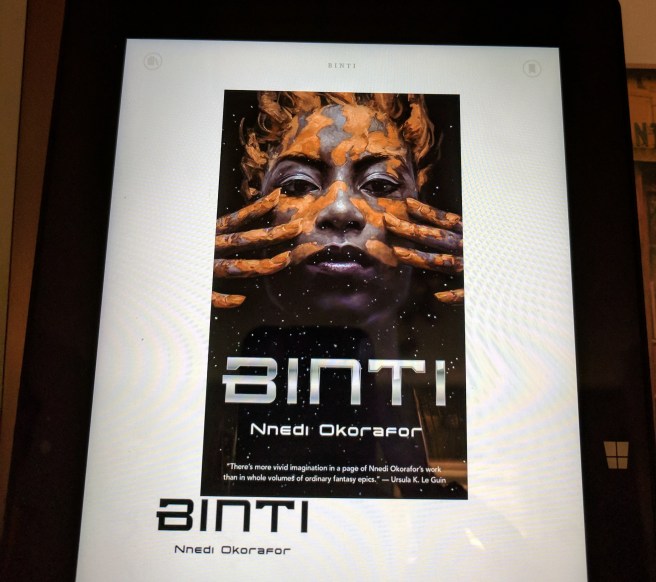
Kindle Binti novella manual picture

The first pillar is the author’s sheer creativity. This is the most inventive and fresh thing I’ve read in months. Nnedi Okorafor’s novella (the first of a set of three) is not really a happy story, but there’s a lightness and a joy in her creation, from biological interstellar ships that are basically giant star-shrimp, to the main character’s tech, based around “harmonizing,” which is a form of mathematical comprehension of the world so deep it may as well be sorcery. Binti uses harmonizing to optimize the astrolabes her family makes their living on. Astrolabes fit the same cultural niche as our smartphones but are much more powerful and beautiful. All this takes place in an afro-futurist world, where tech is extraordinarily advanced and cultural roots run deep. The conflict between the traditional expectations Binti’s family levies on her and her ambition of studying at the galaxy’s most prestigious university planet is the central emotional conceit of the novella.

The second pillar is Okorafor’s realistic attention to emotion. A general flaw of a lot of classic SFF is its treatment of emotion. It’s either overweeningly mawkish or nearly nonexistent. This is why rereads of Heinlein and Asimov just don’t grab me — the emotion that’s there is either too robotic or too overwrought. In Binti, Okorafor gives emotion its due — presents the concerns and internal torments of her characters in a clear and matter-of-fact manner — and then lets their actions as they navigate their problems do the rest of the explaining. Binti neither denies nor overfocuses on emotion. Okorafor plants the internal lives of her characters firmly, then builds the story around them without letting it get weighed down by them.

The third pillar of Binti’s greatness is the “chunk of meat” storytelling style. There’s a chunk of meat on your dinner plate that you don’t recognize. You ask what it is, but the chef shrugs her shoulders and walks away from your table. You are confused, but the presentation is interesting, and the aroma rising from it is irresistible, so you eat it, still lost but enjoying it immensely. “Oh, the main character can use math to generate an advanced meditative state, cool, great…oh ok, the ship she’s taking to university is a giant shrimp with titanium-hard skin. Cool, sure. Huh. Pass the gravy, this is delicious.” Okorafor’s chunk of meat style puts discrete and not-fully-explained pieces of the world in front of you, and the time she saves not info-dumping everything gives an immediacy to the story that carries you on a great wave, like how the Meduse…well, you’ll find out what that species does when you read the novella.

Binti is fresh and strong, from its powerfully-described world to its extremely relatable, loveable main character. Part of the freshness is its afro-futurism, and the impact of reading about an African spacefaring culture is every bit as refreshing as reading fantasy that’s not chock full of ogres and elves. It’s also a vital piece in building diversity in SFF — this triumphal entry in the field makes it a more inclusive and interesting place.