N.K. Jemisin’s Broken Earth Trilogy is the Best Epic Fantasy of the Decade

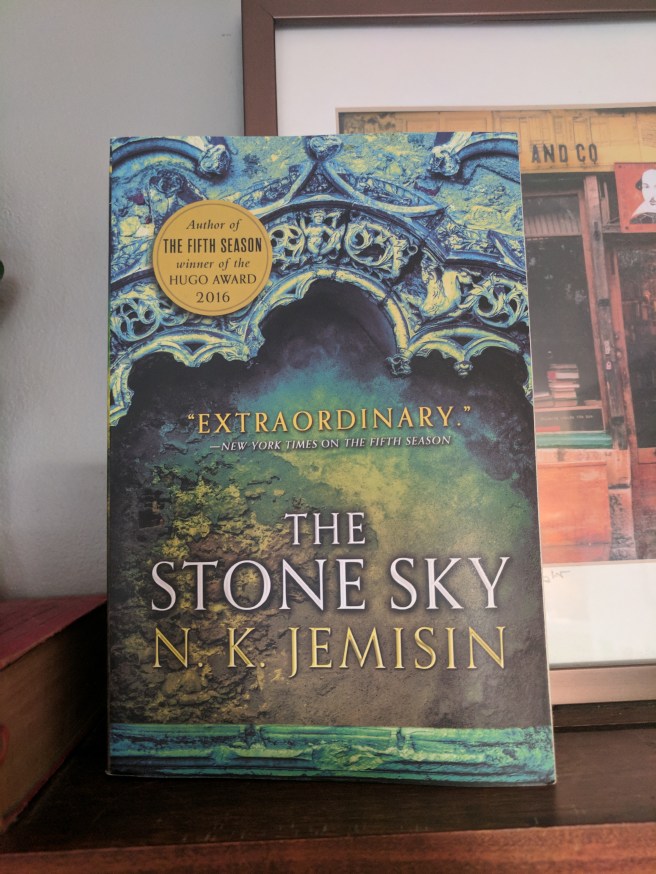
Jemisin brings it to a close with The Stone Sky and demonstrates exactly why the previous two books needed Hugo Awards

N.K. Jemisin’s The Stone Sky is a masterful finish to the most groundbreaking (ha) series of the past decade. Seriously — you can argue about all-time greats, but this is hands-down the most impressive post-millennial series I’ve completed. The world she builds, the characters she creates and how she makes them interact, and the falling-free man-the-ground-sure-is-coming-up-fast gravity of her plotting all combine and balance each other to make this book a place you want to be, filled with people you care about, moving through a plot that satisfies and builds anticipation in alternating cycles until the final payoff. After turning the last page, I felt like I’d been evicted. It was a physical place, with such weight that it left an emptiness behind. The last time I experienced that was 19 years ago in 7th grade, having finished reading about Frodo going off to the Grey Havens. I’d spent a month somewhere, and couldn’t understand why I wasn’t allowed to be there anymore. Jemisin’s world-building alone is Tolkien-level, but she isn’t heavily indebted to him, as a lot of contemporary fantasy is. This is a can’t-miss series for the vivid and original worldbuilding alone, but there’s so much more to recommend it.

If you want to get a small taste before you commit, Jemisin wrote a short story set in the same world a while ago (available in text and audio for free, because Clarkesworld is awesome):

http://clarkesworldmagazine.com/jemisin_07_14/
great book fantasy epic conclusion omg yes!
This book, y’all. It’s where I spent my Sunday.

You can’t have epic fantasy without a map, so where are we?

The Stillness is a single supercontinent that is supernormally tectonically active, criss-crossed with rift lines and volcanoes, all floating precariously atop the anger of the Earth. The extreme inhospitability of this world leads to something called Fifth Seasons, where seismic events create winter conditions for at least six months due to ash blocking the Sun, but they can last for years and have much more interesting effects, such as during the Fungus Season, where extended darkness occurring during monsoon season created a crop-destroying fungal bloom over 20% of the continent, or the Season of Yellow Seas, in which an unknown bacterial agent toxified the seas, causing decades of famine in communities which relied on fishing for sustenance.

The most essential people, without whom humanity would have succumbed to ash and darkness generations ago, are the orogenes, too despised to belong to any caste, but too useful to exterminate. They can perform orogeny, the etymology of which makes me twitch in pleasure. Oros is Greek for mountain, so orogeny is mountain-making, and sweet sassy molassey, that’s exactly what they can do! Magic in this fantasy epic is the manipulation of the heat and kinetic energy of the overactive Earth in a way that allows orogenes to explode volcanoes, raise islands, and create city-slaying earthquakes. It’s this last feature that makes the “orogenically-afflicted” into feared pariahs.

Being feared might kill you, but being feared and useful will lead to the subjugation of your people and an endless cycle of generational misery. Government-trained orogenes who pit their will and power against the fury of the Earth are the only reason humanity is still alive. Untrained orogenes are slaughtered. Trained orogenes who are disobedient are disciplined. If they don’t improve, they are slaughtered. A caste called Guardians does all the disciplining and slaughtering — one example is that, without exception, Guardians break the hands of young orogenes. If they have enough control to keep from causing an earthquake in their fear and pain, their reward is the setting of the bones in their hand. If they don’t have that control, the Guardian kills them. This dichotomy continues throughout their lives — stay useful and be allowed to serve; cease being useful and die.

The solidity and originality of Jemisin’s magic system, the immediacy of danger in the Stillness, and the intricacies of the society that lives there all contribute to making this world feel real. The last bit that does it is a trick used to great effect by Tolkien (and Jemisin): have your story take place on the surface of a depthless past. Most stories evaporate when you shut the book because their thread of narrative is all they have — in LOTR and The Broken Earth, so much happens off-screen that what’s on screen feels much more textured and deep. Stuff has been happening in the Stillness for millennia, and you can feel it. Each chapter ends with a sample from a historical text. Sometimes it’s simple survival stonelore:

Set a flexible central beam at the heart of all structures.
Trust wood, trust stone, but metal rusts.

–Tablet Three, “Structures,” verse one

Other times, it’s heftier:

Our position is thoroughly identified with the physical integrity of the Stillness–for the obvious interest of long-term survival. Maintenance of this land is peculiarly dependent upon seismic equilibrium and by an imperious law of nature, none but the orogenic can establish such. A blow at their bondage is a blow at the very planet. We rule, therefore, that though they bear some resemblance to we of good and wholesome lineage, and through they must be managed with kind hand to the benefit of both bond and free, any degree of orogenic ability must be assumed to negate its corresponding personhood. They are rightfully to be held and regarded as an inferior and dependent species.

–The Second Yumenescene Lore Council’s Declaration on the Rights of the Orogenically Afflicted

Each time, it helps build a larger world for the single narrative to live in. The second example is especially effective because it mirrors reality so well. With a few changes here and there, it could pass for what was written not so long ago in the United States: the specious stuff used to justify slavery in the antebellum South — why, this is for their own good! Why, the good of Society must be our primary concern!

OK, so the world is great, but what’s actually happening in it? (Spoilers Follow)

In The Broken Earth series, the main plot is that a massive, continent-spanning rift has opened, setting off the Season to end all Seasons. Ash starts falling from the sky, raiders start riding across the landscape, and people buckle down and hope. By the time The Stone Sky opens, Essun, a mother searching for her daughter, is helping the community of Castrima migrate to a better location in the hopes of surviving. She’s also committed to appeasing the Earth (who is sentient — I don’t have time to explain, just read the books) by bringing back the moon, whereas her nihilist daughter is planning to use her powers to slam the Moon into the Earth, ending the old bastard once and for all.

great author picture oh my god she wrote the Broken Earth
This is N.K. Jemisin. She made this! All hail the author! Credit: Laura Hanifin | Wikimedia Commons | CC BY-SA 3.0

This untenable situation — a mother desperately trying to find her daughter and redemption for the awful decisions of her past, a daughter currently making awful decisions in reaction to her mother’s, the overwhelming knowledge that if they could just get together and talk it would all be okay OH MY GOD WHY AREN’T THEY TOGETHER YET IF ONLY THEY’D TALK IT WOULD ALL BE BETTER.

The twin motivators — Essun and Nassun have to meet again! and How the hell will they pull this off? Are they going to be able to catch the moon? — keep the pages turning fast and without fatigue. It’s easy to get lost in a world that’s so big when you are deeply invested in what happens to the characters and how the fuck-up of this civilization will be put right.

The amount of information Jemisin gives us about the world in the finale is another reason to keep turning pages. The stone eaters are what? Orogeny was designed? By whom? In addition to creating the forward impulsion of Nassun/Essun // Apocalypse/Peace, Jemisin uses the third installment of her series to answer every single question we have about it, mostly through the flashback chapters about Syl Anagist, an ancient solarpunk city that spanned the world. It gives complete explanations for why the Earth is so angry, why some inhabitants of the stillness have superpowers, and what the hell stone eaters are. Nevermind the explanation of mysteries that have been following us the entire series: it’s a joy to explore the ancient city with Jemisin at the helm. Full of arrogance, far too satisfied with their own power, true, but look at all the cool stuff they had. Another benefit is that it takes this already fully-fleshed-out world, a world you’ve lived in for days (or weeks or years, depending on when you read the books), and makes it just the remnant of a 40,000-year-old far-future society, further increasing the depth and breadth of the world Jemisin built. The resolution in the novel is not just the resolution of two humans, mother and daughter, but of a 40,000-year-long war between humanity and the Earth. Epic doesn’t begin to describe it. The story itself is super cool, but another really interesting thing Jemisin does is make all her main characters awful people. No, seriously.

Oh man these people make bad choices, but who are we to judge?

Jemisin doesn’t shy away from making her characters awful people, and it makes them much more believable. Awful people is maybe too harsh, but they do make awful decisions. Essun, the main character who has been searching for her daughter since Book 1, raised her daughter Nassun in such desperation and fear that she only ever trained her, only ever showed disappointment in weakness, because weakness meant death. Her love was the desperate love of the hunted — never free from the harsh drumbeat survive survive survive. Both mother and daughter are powerful orogenes, in grave danger if they ever reveal what they are. Essun even breaks her daughter’s hand in a horrifying parallel to what her Guardian did to her. It is a cruel torture, but it does ensure the victim has control. Without control, Nassun would be found out and killed. Essun does what is necessary to make sure her daughter lives, to the exclusion of everything that Nassun might see as love. She’s not a bad person. She’s a great mother in one very specific way, and a terrible one in another.

Nassun, ten years old, ripped from her home by a horror she can barely understand, stumbles through a destroyed world until she meets Schaffa, an ex-Guardian seeking redemption. She’s either physically or emotionally estranged from her entire family, and Schaffa (more on him later) gives her the unconditional love she’s craving so desperately. She falls deep into this dependent love, and it leads her to make some problematic decisions. When Schaffa brings her to a Fulcrum (a branch of the organization that sanctions orogenes) she literally kills every single one because, having figured out her mother is a trained orogene, she blames them for making her mother so cold and unfeeling. She goes on to ever-increasing acts of genocide, infected by the absolute nihilism of a ten-year-old who has lost everything she ever cared about. By the end of the book, she is willing to end the world to end its pain, an ambition beyond all but the most accomplished supervillains, but the magic of Jemisin’s writing is you understand exactly how she got there and are reluctant to pass judgment.

The dominant relationship in The Stone Sky is a bizarre cross-time triangle between Essun, Nassun, and Schaffa. Schaffa is the Guardian who broke Essun’s hand, who tortured her for her own good, who hunted her when she ran away. It is horrifying to watch Nassun fall deeply in daughterly love with her mother’s tormentor. The years (ahem, spoiler centuries) he spent instilling dependent love in others as a Guardian makes it a hard habit to break. Here’s the thing though: as toxic as his love is, and as dangerous as he is, he truly does love his charges, at least by his own lights. That makes it so much creepier.

You understand each and every character, from the most saintly to the most despicable, what their motivations are, and what they’ve done. My favorite quote about literature is George Saunders’ about fiction being an empathy-generating machine, and Jemisin’s machine is ticking over nicely. I might be horrified by some characters’ actions, but I understand why they did them, and that’s a luxury most readers don’t enjoy.

Go get The Stone Sky, and get it now (or the whole series, if you’re behind)

There is so much I couldn’t say here. I try to keep these under 1500 words, and I’m over 2,000 right now, but there’s so much greatness in these books that, if I tried to explore it all the result would be unreadable. The balanced, clear writing? How Jemisin pays attention to racial differences in a way that most fantasy doesn’t (most fantasy just assumes everyone’s white)? How badass the fight scenes are? Exactly what Guardians are and where they get their power? How orogeny is actually just magic and much more than rock-throwing? How freaking cool stone eaters are? This work is too big, too expansive, to discuss everything that’s in it in a single blog post, and my inability to discuss it comprehensively is the single greatest indicator of it being literally epic, as in “heroic or grand in scale or character” dictionary-level epic. It’s too big to talk about. I can’t share it with you here. You only have one option. Go read it!
How Agatha Christie’s The Murder at the Vicarage Helped me Mourn my Mom’s Death

My mother loved the Queen of Crime Fiction, and for good reason, it turns out

Agatha Christie has been outsold by two people: Shakespeare and God. The only books to outsell hers are Shakespeare’s plays and the Bible. Despite that popularity, I was not impressed by my first foray into her works, The Murder of Roger Ackroyd, and I was even less impressed by The A.B.C. Murders. While the first was enjoyable, and played with the conventions of mystery novels in one very particular and striking way, it didn’t grab me. The second I found gimmicky and empty. I rather agreed with Raymond Chandler, who characterized what happens in English detective stories as “the same old futzing around with timetables and bits of charred paper and who trampled the jolly old flowering arbutus under the library window.” As happens so often, actual knowledge of something is all that’s necessary to kill disdain for it. I crossed that barrier with The Murder at the Vicarage, the book I buried with my mother.

Agatha Christie's book
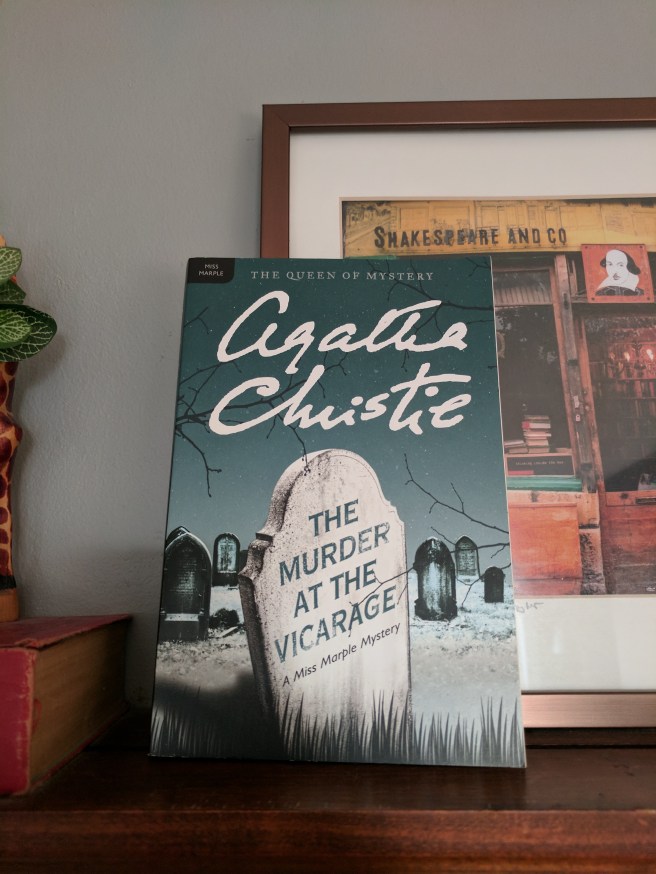
Agatha Christie’s The Murder at the Vicarage, with shelf

My mother loved reading. It was her defining hobby, and she loved Agatha Christie especially, having read every book she wrote. So, in the surreal logic of grief, I decided to put one copy of Christie’s work in the ground with her, so she’d have something to do. The copy was The Murder at the Vicarage, for the simple reason that it was one of the first to come to hand when I reached into her massive Agatha Christie cupboard. Once I was home after the back and forth and tumult of the funeral, I turned all my energy to consuming that book as fast as possible. If it was worth burying with my mom, surely it was worth reading, right? I read it on my phone while waiting in line, listened to it in my car while commuting, and spent a lot of time reading it normally at night. It was my last goodbye, and I wanted to give it the attention it deserved. The result was going at breakneck speed through the work of a master craftswoman. She’s pretty amazing, y’all.

So, what is The Murder at the Vicarage actually about?

The Murder at the Vicarage is narrated by a village vicar, Leonard Clement. He’s married to a much younger wife, Griselda Clement. After a few introductory pages, a man that everyone in the village despises to varying levels, Colonel Protheroe, is found shot through the head in the vicar’s study. The book after that point introduces many characters, all who had a reason to dislike the insufferable Colonel, and explores various scenarios under which they could have killed the victim. The only person who can see through all the chaff of misdirection is Miss Marple, in her first outing as one of Christie’s best-loved sleuths. Maybe she’s the reason why this ended up being the book I chose from among the handful I pulled off my mother’s bookshelf — the detective is an old lady of hidden depths and impressive intelligence (hi my mom was like, smart as hell).

Why Agatha Christie’s murder mysteries are so good

Crime writer Agatha Christie
Dame Agatha Christie. She sees right through you.

Agatha Christie is escapist literature, definitely, so long as the people using that term aren’t dull enough to think it’s shorthand for less-than or non-literary. She’s one of the most impressive craftsmen I’ve ever read. She builds plots like the Swiss build clocks — everything is tiny, seemingly insignificant, but it all fits together in clear and important ways once the work is done. Through and around all the logic puzzles and plot twists, there is strong, clear writing and an impressively deep understanding of human nature.

For people who are addicted to Agatha Christie, a good portion of the fun is figuring out whodunnit. I’m abysmal at this — I had not the least suspicion of the actual evildoers at any point throughout any of the three Christie books I’ve read. Dad tells me that mom got to where she could get it right about half the time. The thing that seems almost unfair, paradoxically, is that Dame Christie gives you everything you need to know exactly who murdered whom. The mystery is built perfectly — the answer is hidden, but each detail on each page of the story fits seamlessly with all others to point to only one conclusion — if you’ve got the skill to slot them together in the right order. I do not. In this particular book, the narrator runs across the killer carrying a rock. This is damning evidence, but neither the narrator nor I has any idea. Generally, you’re not smart enough to figure it out, but there’s a lot of pleasure in the examination of every little occurrence and the formation of your (in my case) inevitably wrong theory. This exercise completely occupies the mind, and pulls your brain more fully into the book than with other escapist literature. It’s half small-town dialogue and half LSAT logic puzzle.

The sheer strength and clarity of writing is a joy to read. It’s the style of writing that many of the best use, where you don’t even realize how powerfully that style is building a world around you, putting you exactly where it wants you. The powerful can make you do or feel what they want, but the truly powerful make you do it without even realizing it. It’s so strong it doesn’t need to be showy. Just an example, without further commentary:

“You see,” she began at last, “living alone, as I do, in a rather out-of-the-way part of the world, one has to have a hobby. There is, of course, woolwork, and Guides, and Welfare, and sketching, but my hobby is–and always has been–Human Nature. So varied–and so very fascinating. And, of course, in a small village, with nothing to distract one, one has such ample opportunity for becoming what I might call proficient in one’s study.”

This is the source of Miss Marple’s power. Sure, her template is just that of the nosy old neighbor, but add to that her keen intelligence and singular understanding of human nature, and she’s a dangerous adversary. There’s something so delicious in an unassuming old lady, ignored by most and feared by none, having the perspicacity to pierce through to the truth and undo all the careful plotting of the murderer.

Another of Miss Marple’s quotes, savage to the extreme, was on the subject of her modern novelist nephew:

“His poems have no capital letters in them, which is, I believe, the essence of modernity. His books are about unpleasant people leading lives of surpassing dullness.”

Unassuming old lady, able to tear the heart out of anyone who doesn’t impress her. I also particularly love this quote because it’s so true. I love modern fiction on the level of Midnight’s Children or Infinite Jest, but so much gets a pass as serious literature simply because it’s boring and miserable, which must mean it is Important. The 100 pages of Franzen’s The Corrections to which I had the fortitude to subject myself is some of the worst “literature” I’ve ever read. Unpleasant people and lives of surpassing dullness, indeed.

Agatha Christie, my mother, and me

Me, mom, dad, sister on a bridge in nature
My favorite family photo, featuring my dad, who is a big reason I love nature and didn’t end up an indoor kid. I’ll never have to write anything about that, because he’s going to live forever.

Agatha Christie gives you plenty to chew on in this novel. The frantic fitting together of every little detail as you read, hoping to prove to yourself that you’re smart enough to figure it out before the big reveal. The satisfaction of the big reveal itself, as the intricate structure of everything she’s built up to that point becomes apparent. The deep understanding of people, what they want, and how they act. Christie pulling all this out of a small village in the middle of a quiet old English county is perhaps the most impressive thing she does. It reflects actual life so well — no matter how little is happening, no matter how boring something appears to be, there is always depth to it, like a drop of water under a microscope shows an entire unimagined world, teeming with microbes.

It helped me grieve for my mother because while I was reading it, she was right there with me. I’m so much like her that she won’t be gone until I stop breathing, and it’s comforting to be reminded of that. After I type these last words, I’ll stumble off to the kitchen, make myself salmon with shishito peppers, and watch The Defenders, continuing to lead a motherless life. While I’m writing this, and while reading The Murder at the Vicarage, I’m not motherless. Reading and writing are so much of my inheritance from her that doing those things brings her back. She’s with me, not in a mystical sense, but because she built who I am. 

Anyway, The Murder at the Vicarage is a good book, and you should probably read it.

Ursula K. Le Guin’s The Word of Unbinding is a perfect short story

Le Guin’s first Earthsea tale is one of her best

I just read one of Ursula K. Le Guin’s first short stories, and it was so perfect it completely derailed my original plans for this post. I have to write this love letter to my favorite author. No one alive comes close to her flawless creation of whole worlds from a handful of sentences, and no one has a deeper speculative-anthropological interest in what humanity is and should be.

I don’t remember the first time I read one of her books — it happened in that post-high-school flurry of absolutely unbound devouring, where you’re no longer reading what you feel you “have to” to be taken seriously, but what you want to — the rubber-band snapping of freedom is disorienting, but it’s wonderful to no longer have to pretend you understand Gravity’s Rainbow at 17 years old.

In that frenzy of consumption, something of hers was tossed in, but where she really grabbed me and never let go was with The Dispossessed. A piece of Science Fiction so perfectly balanced, so perfectly human, serious without confusing being serious with being boring and grim, that I have never forgotten it. It fairly and clearly represents the benefits and flaws of a capitalist and anarchist society (two different planets locked in co-orbital positions, one desert-anarchist, the other lush-capitalist). Capitalism is not all subjugation of the poor (although that is an unavoidable side-effect, if not a planned feature), and anarchism is not all lighting fires and throwing stones — all anarchy means is the absence of hierarchical power structures. UKL shows there’s beauty and flaws in both systems because both systems are run by inherently fallible people.

Ursula K. Le Guin at the 2014 National Book Awards

She’s a bona fide hero. If you need proof, here’s her speech at the 2014 National Book Awards, where she received the Medal for Distinguished Contribution to American Letters:

In a room filled with book publishers, at an event sponsored by Amazon, she took the industry to task for “letting commodity profiteers sell us like deodorant” and said, “We live in capitalism. Its power seems inescapable, but so did the divine right of kings.”

That was UKL the doyenne of American SF. This story is from Ursula K. Le Guin, the barely-published writer, and she already had the magic.

The Word of Unbinding: a ten-minute story packed with everything Ursula K. Le Guin would become

In The Word of Unbinding, we already see all the elements that make UKL who she is as an author. Language as simple and clear as a forest stream. The ability to plant twenty words, step back, and watch them grow into an entire vivid world. A focus on the importance of balance, acceptance, and doing the right, the human thing. Before going further, please read the story. It is without a doubt the most worthwhile thing you will do today — doubtless more worthwhile than reading this blog.

The Word of Unbinding is an exceedingly simple story. A wizard is trapped in a dark well, guarded by strange creatures and magics, and he tries and fails to escape until there is only one way out. Like all of UKL’s writing, it is simple and straightforward, but so incredibly dense. Not in the James Joyce/Thomas Pynchon sense, but in the sense that each word is so carefully chosen and placed it’s like setting stone on stone. Here’s the first line:

Where was he? The floor was hard and slimy, the air black and stinking, and that was all there was.

She accomplishes everything she needs to in twenty words. The protagonist is lost and confused, something bad has happened to him, bad air, hard floor, and that’s it. Before there’s any chance of remotely understanding what’s going on, there’s a rock-solid sense of where the story is. Next step is explaining who the protagonist, Festin, is:

Lately, in these lone years in the middle of his life, he had been burdened with a sense of waste, of unspent strength; so, needing to learn patience, he had left the villages and gone to converse with trees, especially oaks, chestnuts, and the grey alders whose roots are in profound communication with running water. It had been six months since he had spoken to a human being. He had been busy with essentials, casting no spells and bothering no one.

UKL’s conception of how magic works and what its practitioners should be is the most compelling in all of literature. This isn’t clear from the excerpt, but her system is almost entirely based on naming. Everything in existence has a True Name, and innate power wedded to study and discovery of these names gives a wizard their abilities: just like a writer, they use language to call forth miracles, to change the reality around them. What is clear from the excerpt is what a wizard should be: Festin has not cast a spell in half a year. Magic is not about fireballs and parlor tricks, but about balance. Each and every wizard has a responsibility to maintain and protect that balance — that is what makes them a wizard. The upsetting of that balance is the source of evil, in this story as elsewhere in Earthsea (UKL’s fantasy territory).

burgwald_025
Le Guin describes herself as “the most arboreal science fiction writer.” She’s not wrong. Credit: Nikanos | CC BY-SA 2.5

A wizard reaver named Voll goes from island to island, destroying towns and enslaving people, disrupting the natural order. He seals the protagonist in a dark well-tomb. Festin, confident in his power, attempts to escape repeatedly. First as a creeping mist, then as simple air, then as a falcon, then as a trout. He is successively foiled with a blast of hot air, a storm wind, an arrow, and a fisherman’s net. Broken, cold, and kept on the edge of death, he begins wondering why his enemy will not kill him. After due consideration, he takes the last path out of his situation — the word of unbinding:

So Festin made his choice. His last thought was, If I am wrong, men will think I was a coward. But he did not linger on this thought. Turning his head a little to the side, he closed his eyes, took a last deep breath, and whispered the word of unbinding, which is only spoken once.

Festin, seeing his situation and a possible way to restore balance, makes the human (in its least cynical definition) decision and accepts the change required to set things right. Once in the land of the dead, a land of hard obsidian lava flows, black grass, and unmoving stars, he discovers Voll is long dead but has somehow returned to the world. He chases his enemy back to his corpse, forces him to re-enter it, and then sits vigil at the point of origin for the imbalance, guarding against further upset.

Festin saves the world through acceptance of the most human fact there is: all will die and turn to dust. If he had attempted to avoid what must be, he would have remained trapped and ineffective, unable to bring battle to Voll on any plane that mattered.

Cultivating imbalance for personal gain unerringly leads to evil and is set right through courageous acceptance of what must be.

This story floored me not simply because it was so perfect, so small yet so powerful, but because this is one of the first things UKL ever published, and she was already a master. She further developed her talent over a decades-long career, but everything she needed was already there: the power and clarity of her language, the strength of her perception of the world she’s creating, and the strong philosophical attachment to balance. Not to mention it’s a super fun wizard adventure story, written 53 years ago and still wonderful and fresh today.

Logan is a great balance of comic book movie action and painful emotional tragedy

And by great balance, I mean both aspects are set to 11 in Hugh Jackman’s last X-Men film

Logan gives Wolverine, one of the most popular comic book movie stars, a great sendoff. I suppose Wolverine himself won’t be leaving, but Hugh Jackman, the main reason the character is so popular, will be, and apparently he’s taking Patrick Stewart with him. The movie is a bit like Driving Miss Daisy, if Morgan Freeman were an alcoholic who just couldn’t seem to stop manufacturing amputees and Miss Daisy were an extremely dangerous telepath. The movie takes place years in the future. Charles Xavier has some type of degenerative brain disease, and whenever he has a seizure, he paralyzes everyone within a certain radius (including their lungs), so he’s living in a hole in the middle of nowhere. Logan is supporting him by driving a limo, apparently. All the other X-Men are dead. New mutants are not being born. Something is killing Logan slowly and painfully, and he’s drinking a lot and finally looking old (he was born in the 1880s). He’s aging, covered in scars, and limping, so his healing factor is ominously not working so well anymore. Add to this the sudden arrival of Wolverine’s murderous daughter clone Laura, who is on the run from the people who trained her as an assassin, and we’re off to the races! Spoilers follow. I guess they preceded too, but they really follow.

Logan is realistic, for a given value of realistic

The first thing that stands out about this film and sets it apart from other entries in the franchise, that makes it memorable (the only thing I remember of X-Men Apocalypse is an angry blue man and a collapsing pyramid) is its unstinting realism. If you replaced Logan’s claws with guns and his on-the-fritz healing factor with some good old-fashioned plot armor, John Wick style (ok John, maybe you have a bulletproof suit, but there’s a finite number of times people can shoot at you before one gets lucky and hits you in the face), and this could be a grim, gritty thriller movie about a grizzled ex-warrior who just wants to save his daughter.

Reality is the backbone of this superhero movie, which sounds weird when you get into the secret corporate labs, the kids with superpowers, and the man with giant claws. I’ll try to explain. The Hangover was just a movie about a group of guys going to Vegas, gambling, and getting drunk, nothing supernatural at all, but the underlying feel of it was completely unrealistic. It goes the opposite way in Logan. It’s a movie about a 150-year-old with a clone daughter and a telepath father figure all being hunted by a transhuman mercenary force, but underneath the superhero trappings is a story about age, and death, and loss. This is where the acting chops of Patrick Stewart and Hugh Jackman really come through. Those two men have carried most X-Men movies (with some help from Ian McKellen), and they are at the top of their form in this one. Stewart plays a feeble, confused, half-crazy Professor X perfectly — every line of his body radiates weakness, his voice cracks, he’s so frustrated at his helplessness he curses at Logan (yes, Professor X drops an F-bomb in this movie). Every single time you see Hugh Jackman’s face, decades of loss and disappointment hit you like a truck. His every movement, grunt, and word shows a man who is done with life, waiting to die. Their acting makes the movie work, and it’s so wrenching to watch this performance realizing you’ll never see them in these roles again.

Wolverine on a rock
20th Century Fox has every image of Wolverine extremely copyrighted, so here’s this one. Credit: Jonathan Othén | Wikimedia Commons | CC BY-SA 4.0

It’s not just those two characters that make this grim. The entire world they live in is terrible — the X-Men are all dead (most likely killed by Xavier when he first started having these attacks), the anti-mutant corporations are ascendant and hunting down anyone who is left, and one of the most beloved characters of the franchise is contemplating suicide. Everything is awful, nothing is good. 20th Century Fox brings you in with a promise of X-Men action, and you find yourself trying to eat popcorn to a Sartre play. Again, that’s part of what makes this movie so refreshing compared to the others, and it’s not like they don’t also deliver the action goods.

If you think Wolverine is violent, you should meet his daughter

This movie is not as action-packed as others in the franchise, but the little it does have really delivers. After a brief intro fight, Logan spends a lot of time just driving around, getting drunk, and taking care of Professor X. He meets his clone daughter and still nothing cool happens. She just sits in their hideout eating cereal. Just as you despair of seeing an X-Men movie at all, the mercenaries show up to take her back. They easily subdue Wolverine and send a couple men into the building to get her. You hear some screams, and she comes out and throws a SEVERED HEAD at the leader, then throws herself on the enemy with a viciousness paralleling only that of Wolverine himself. Her fighting style is acrobatic, and involves a lot of evasion, landing on people’s shoulders, and neck-stabbing. Whoever choreographed it should get a medal. It’s a joy to watch, and the incongruousness of a ten-year-old girl effortlessly murdering beefy, lumbering soldiers gives you a sensation that lands somewhere between hilarity and extreme discomfort.

Wolverine’s fighting style is more labored — less balletic but just as bloody. Laura (the clone daughter) fights like someone holding a samurai sword, and Logan fights like a guy holding a bat with nails in. He’s old, and he’s slow, and he can’t shrug off damage like he used to, but he’s still got the killer instinct. He struggles for every inch he gets, and that makes the fights more fun to watch. Too often in superhero movies, it’s hard to see how hard someone is working. Mutants with energy-based or telekinetic powers are fighting for their lives, and, oh boy, it’s time for them to really turn it up, and all they do is…grunt a little more and squinch up their face. Logan does not have that problem — he is no longer an elite fighter, but he just does not stop, and you see his determination in every muscle flex, every enemy punch deflected, and every bodyblow absorbed. It really means something when he finally sinks his claws in someone. Speaking of sinking claws in people, they actually show it. It never made sense in the other X-Men movies when Wolverine would stab someone and the guy would just bloodlessly hit the ground. Well, Logan is rated R, and holy hell it shows. His fights involve multiple amputations, buckets of gore, and lots of realistic stabbing. When he puts his claws into someone’s skull, you see them come out the other side covered in brain matter. It’s so graphic it’s uncomfortable, but it’s better than the touch football version of fighting he was using in previous movies.

Let’s talk about Logan’s feelings

I spent so much time talking about the action scenes because that’s how you approach an X-Men movie, right? How cool the fighting is, how much fun it is to watch people use their powers, etc. There’s another level to this movie though: actual character development and a real focus on the human side of things. These are people, not superheroes. Many of the previous X-Men films tried to carry the whole emotional arc of the movie on the back of the old tension between Magneto and Professor X. It gets stale. In Logan, a half-feral mute falls in love with her genetic father and learns that murdering everyone all the time is maybe problematic. A man who was one of the most powerful and respected mutants of all time is now feeble and dying, desperately trying to advise his last surviving pupil (Wolverine) to do something that really matters. An old, cynical loner who is convinced the last thing left for him to do in this world is leave it finds something to care about. That last one sounds corny, and I suppose it is, but the difference with Logan and other “heart of gold” stories is that Logan absolutely does not have a heart of gold. He’s an old, angry Canadian, and his heart is full of bitters and blue ruin, full stop. By the end of the movie, he has a heart that is maybe a bit shiny if you catch it in the right light, but that’s it.

Maple syrup on a table, only thing better from Canada is Wolverine
Maple syrup, the best thing America has imported from Canada after Wolverine. Credit: Miguel Andrade

Another good human touch to this movie is the humor. There’s not much, god knows, but it is there. Xavier and Logan bicker like an old married couple. The girl does not understand that violence doesn’t solve everything (mostly because it does solve everything). For example, they are at a gas station and she’s riding a little mechanical rocking horse. When it stops, she flies into a rage and is about to murder the coinbox to get more money when Logan just hands her a quarter and gives her a look. Another thing I found funny (and I’m not sure if this is intentional) is that almost every single mercenary chasing Laura has at least one robotic arm, which you absolutely would need if you spent your days raising a baby Wolverine. These small, almost non-existent touches of humor are pleasant in this film, and in a more general sense are what makes the Marvel (not actually the same studio as this one, but whatever) movies more successful than the DC ones — they have a sense of humor. The recent Batman/Superman movie was so terrified of looking goofy that it ended up looking like a steaming pile of gloomy, humorless garbage. There’s got to be a little humor, no matter how serious the movie, because there’s always a little humor in people, no matter how serious the person.

Logan: the rest is silence

There are plenty of scenes of mutant-fueled carnage in this film, more than enough to satisfy the moviegoer who just wants to see Hugh Jackman kill stuff, but the real focus of the movie is an assemblage of deeply broken people taking action to do something that matters, regardless of how much the sharp edges of their shattered pasts grind together within them with every step they take. The beginning, middle, and end of the movie are exercises in unremitting tragedy, which a.) might be overkill but b.) some people’s lives really are that bad. I definitely got something different than what I was expecting, but most of the unexpected was great.

In the climax of the movie, old, almost-dead Logan takes an injection of a serum that supercharges his powers. He’s finally back in form, ready to tear apart a legion of soldiers without breaking a sweat. Wolverine finally achieving full strength was extremely gratifying to the part of me that watched X-Men cartoons as a kid, but the gritty emotional realism comes through here as well. He’s not just back physically, but emotionally as well, finally ready to fight for the person he loves. In the climax, the two focuses of this movie — serious emotional piece and action-packed superhero film — come together like hydrogen and oxygen, in a way that entirely satisfies the part of me that will always love any movie that involves Arnold Schwarzenegger + guns and the part of me that makes a point of watching whichever film won the Oscar that year. I left the theater not sure if I liked the movie or not, not sure exactly what I had watched, and that is a result of the director taking a risk with this film, which is almost always better than doing a retread of a successful formula. After a week’s reflection, it’s clear that any movie that can successfully blend well-done action escapism with emotional catharsis is a great achievement.