Lincoln in the Bardo Redux: Still Weird, Still Great

Most weeks, this blog is about a different book. Lincoln in the Bardo is so important that it gets two posts. It’s seriously good. It’s hard to call this stuff, but it might be the next big thing people look back at in a century and think “Whoa, there was a forking path in the history of art.” One of the areas in which Saunders was most inventive was how he constructed 166 completely distinct characters in a single book, so I asked him about that.

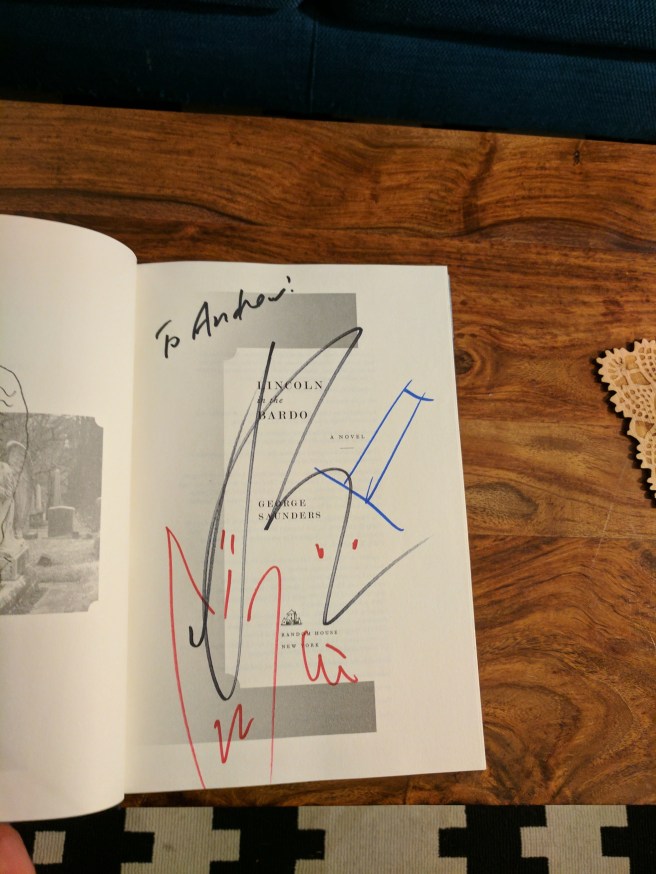
I was lucky enough to go see Saunders speak about his book. The event took place in a church, because the demand was so heavy that the nearby bookstore couldn’t accommodate it. High ceilings, arches, stained glass, and a guy from Chicago standing at the pulpit talking about art. It was a really great night, and I got to ask him a question about what his process was for making all those different voices sound so very different. What follows is an inexpertly copied transcript, with changes made for the various uncertainties of human speech (ums, ahs, you knows). My question was about how different each character sounded, but the answer I got was about his entire philosophy of writing. It was extremely gratifying. Thanks, George!
img_20170304_004759
He drew me a ghost and a Lincoln inside his signature. I mean, he drew that for everyone, but he also drew it for me.

Anyway, here it is:

Q: When I was reading, what I was most impressed with was how sharply distinct each voice was, and doing that with 160-odd characters, even the ones that are just there for like, half a page, hello-goodbye, I was just wondering what went into making those voices so clear and distinct.

A: Oh thank you, yeah. You know, in my short fiction, it’s always in a contemporary voice; I’ll often have two or three characters, and I really try hard to distinguish them in voice, and that means going really overboard on two or three voices. In this book as soon as I realized how many people there were going to be, there’s a hundred-sixty-six, I thought, I have to maybe scale it down just a bit so I can sort of make that many versions. And the approach really was, I mean, my whole thing on writing is, it’s based on a three-part mantra. Donald Barthelme said, ‘The writer is a person who, embarking on her task, does not know what to do.’ Gerald Stern, in a slightly different register, and I’ll clean this up because we’re in church, ‘If you set out to write a poem about two dogs making love, and you write a poem about two dogs making love, then you wrote a poem about two dogs making love.’ And then Einstein, taking it up another level, as he always did, said, ‘No worthy problem is ever solved on the plane of its original conception,’ which for artists is a real deep thing. If the thing only is what you thought it was gonna be, then you’ve disappointed. So, in my process, I’m always just kind of proceeding at speed, trying to have as few notions about it as I can, almost imagining like there’s a meter in my head with ‘P’ over here for positive, ‘N’ over here for negative, and the job is just to read, and revise, and watch that needle, without any sort of attachment to where you wanted to be. So, it’s up in the positive, if it goes in the negative, you don’t do that thing where you say, ‘Oh no it didn’t,’ and you also don’t do the thing that says, ‘I suck. I have to go back to law school.’ You just say, what you kinda do is, and my thing is you sorta turn to the story and you say, ‘Hey, I notice you’re down in the negative here,’ and the story will go, ‘No I’m not,’ and you say, ‘Well, I kinda think you are, it’s okay, I still love you,’ and it says, ‘Ah yeah, well,’ and you say, ‘Well, what’s the problem, what’s the problem with the story?’ And it goes, ‘I’m boring.’

‘You are boring, you poor thing. Can you tell me, where are you boring?’

‘Page six.’

‘Ok, I agree. Where exactly?’

‘Third line.’

And you go to the third line, and it says like, ‘Bill sat at the empty table, the black planar expanse, the dark flatness,’ and you go ‘Oh yeah, I get it.’

So it’s a very intuitive approach, and it’s kinda based on the idea that when we’re reading, something crazy’s going on in the mind; it’s so intelligent, and it’s picking up so many signals off the text that are kinda subverbal, you couldn’t articulate them. So in that heightened beautiful state, reader and writer together kind of reach this communion, basically. So, when I’m writing I’m trying to make the voices (to come back, finally, to your question), I think what I do is I try to be as deep in the text as I can, and then I turn over and say OK I need a ghost over here, and then, this is the scary part, I just trust the verbal overflow. You know at that point, a voice will appear, as you’re typing, bom bom bom. So, the trick is to not say, ‘I don’t want that ghost,’ or ‘What does that ghost mean?’ but just like, ‘Go ahead, tell me,’ you know. And so it’s sort of a sustained improvisation, and even with that number of characters you kinda remember what you’ve done before, and your subconscious is moving you away from those, so it’s kind of a crazy process of believing there’s a part of your mind that’s smarter than the surface part, and then sort of allowing that to come through.

So there’s a small piece of George Saunders’ writing process, which I was super excited to hear. Whether he’s the greatest living American writer is a matter of opinion, but he’s doubtlessly in the running. Part of why he’s where he is, and part of what his answer makes clear, is he takes his writing as seriously as a heart surgeon takes his work. He’s not just, you know, telling some story or whatever. He’s telling the perfect story, the only story that could grow in the space in which he’s working. If you haven’t checked out his entire opus, you really should.


Rick and Morty is what happens when Dan Harmon gets carte blanche

I am extraordinarily late to this party, but Rick and Morty is the best currently-running cartoon on television. It’s also currently available for free on the Adult Swim website. It is endlessly inventive, does not shy away from complexity, and does a surprisingly good job on exploring character traits for a 23-minute show. It’s the baby of Dan Harmon, so if you liked the absolute absurdity of some of Community’s plotlines, you’ll appreciate the same style. The absurdity coupled with the effectively limitless conceptual space of the SF setting results in a show that is constantly entertaining because it’s constantly new. Think about all the times Community got ridiculous — the Halloween zombie episode, the paintball episode, etc. — and then think about what would happen if you moved that aesthetic from a show about community college to a show about a dimension-jumping intergalactic mad scientist with no moral compass. I’m getting ahead of myself. This show is about a dimension-jumping intergalactic mad scientist with no moral compass, a cynical, alcoholic 60-year-old who is probably the smartest being in existence. He’s a man who built a robot at the breakfast table because he needed something to pass him the butter. He built a butter-passing robot in like two minutes because he was lazy.

The eponymous pair of the show is this super-genius, Rick and his rather stupid grandson, Morty. Rick has returned to the family after years of absence, and his daughter Beth has abandonment issues and is terrified he’ll leave again. This creates tension with her husband, Jerry, who does not like Rick because he makes him feel stupid (he is) and has a bad influence on his son. There’s also Morty’s sister, Summer, who is mostly interesting because she’s a normal teenage girl — she’s the only character who is not dysfunctional. The relationship of these characters is one hint of the greatness of this show. It’s a zany sci-fi hijinks cartoon that also addresses the reality of human interaction. For example, the failing marriage between Morty’s mom and dad, two deeply hurt and codependent people, is an ongoing topic across all episodes.

The main draw of the show is its sheer inventiveness. In one episode, Jerry is annoyed that the family dog is so stupid. He pesters Rick until he solves the problem by putting an intelligence helmet on the dog. The dog spends a little while fetching slippers, using the toilet, etc. Then he achieves self-awareness, modifies his helmet to bestow super-intelligence, enslaves the family, and starts building an enhanced dog army. In another episode, Rick gives the family a Mr. Meeseeks box. The box is alien tech. When the user hits a button, a humanoid Mr. Meeseeks pops into existence, solves a problem you set for it, and then de-manifests. The dad, Jerry, asks for help getting two strokes off his golf game, but he’s so bad at everything that the Meeseeks can’t help him, gets distraught, and hits the Meeseeks button itself, asking a second Meeseeks to help it help Jerry. This process repeats until there are dozens of Mr. Meeseeks all experiencing an existential crisis. The only way to stop a homicidal rampage is for Jerry to actually improve his golf game. There’s the one where aliens place Rick and Morty (and accidentally Jerry) in a simulation of their normal lives, hoping to trick Rick into giving them one of his technological secrets. The problem is, the simulation is really low-rent, and the only person dumb enough not to notice anything wrong (people walking through trees, his wife responding to him robotically and using the exact same words, seeing the same three people over and over again throughout the town due to the limits of the simulation’s processing power) is Jerry, and as a result, the poor guy has the best day of his life. Every episode has some high-concept core around which all the wackiness happens. The cardinal sin of bad art in any medium is to be boring, and this constant renewal of ideas puts Rick and Morty on the opposite side of that spectrum.

The interactions between Rick and Morty also add to the show’s appeal. On one side, you have a sociopathic genius who once built an entire pocket universe, filled with beings to whom he was a god, just to use as a car battery. On the other, there’s a kid who isn’t that smart, but also thinks that maybe doing whatever you want with no regard for destruction, mayhem, or morals maybe isn’t the best path. For example:

This is a pretty good encapsulation of what the show is all about. Rick sells a gun to an assassin to get enough money to go to a galactic Dave and Buster’s. Morty, horrified at his callous disregard for life, refuses to have a good time. This has all the other elements of a Rick and Morty show: the weirdness of them going to a galactic arcade, the variety of all the background aliens there, the high-concept of one of the arcade games taking the player through an entire life from childhood through death, the cynicism of Rick saying “55 years, not bad!” while Morty, still confused from the virtual reality, desperately asks “Where’s my wife?!”

The key element that ties everything else together is Rick himself. The character is so compelling because of the dynamic tension between wanting to root for the smartest guy in the room and being horrified by what a complete sociopath he is. He can out-think anyone, build the coolest machines, and take his grandson on eye-opening adventures of breathtaking scope. On the other hand, he abandoned his daughter, is a galactic criminal, and seems literally not to care about anyone’s life, human, alien, or otherwise. He embodies the Darth Vader/Walter White effect, in which individuals of extraordinary competence, no matter how morally repugnant, appeal to audiences. Also, although he is completely unrepentant, he does have one single redeeming factor that the show buries deep: whenever he has to choose between the safety of his family and himself, he sacrifices himself. That one tiny spot of humanity colors the rest of his character and elevates him (just barely) to good-guy status. Well, not a “good” guy, but you get the picture.

The last episode of this show came out a year and a half ago, after a hell of a cliffhanger. Legions of fans have been painfully awaiting its return, and now I join their ranks. However long it takes for season three to premiere, it will be worth the wait. I’ll leave you with one more clip that will probably serve as a better indication of whether you should invest in this show than anything I’ve said. It’s the cold open for one of the episodes. If it makes you laugh, watch the show. If it’s too weird and off-putting for you, don’t watch the show.


George Saunders’ first novel, Lincoln in the Bardo, is just as weird as you’d expect

Abraham Lincoln, one of the characters of George Saunders' Lincoln in the Bardo, looking sad and withdrawn.

George Saunders’ recent Lincoln in the Bardo is the most interesting thing I’ll read all year. Saunders’ career is built on finding the small, the unlovable people of the world and constructing a story around them purpose-built to carve a them-sized cavity in your heart,  to demonstrate forcefully why they, yes, even they, are deserving of love, or at least pity. His writing is very Sermon-on-the-Mount, and encourages us to have empathy for the unfortunate and understanding for the contemptible. Saunders’ career is also built on short stories, and it’s exciting to get a novel out of him. As you might expect from someone who started his career as a geophysical engineer, it strays far from novelistic conventions. So what exactly is it?

In my outline for this part, the first bullet point was “Hoo boy.” Where even to start? I guess with an explanation of what “Lincoln,” “in” and “the Bardo” mean. The bardo is a state of spiritual transition in Tibetan Buddhism. After death, those freshly severed from their bodies linger in a liminal state, awaiting the start of their next life. The one and only setting of the book is Oak Hill Cemetery, where young Willie Lincoln lingers, awaiting his father. He died young from a fever just as the Civil War was really ramping up. The book also features the leader of the sundered Union, Abraham himself, who repeatedly visits his boy’s corpse, unable to move on, just like his recently deceased son.

willie_lincoln
Willie Lincoln, the center of the book.

Willie is not alone in the bardo. Oak Hill Cemetery is filled with the archetypes of all the feckless people Saunders tends to write about. In fact, the book is mostly about them. There’s the old man who married a young bride, but died just before consummation. There’s the gay man who slit his wrists and, just as the percussion of blood on porcelain hit his ears, changed his mind. There’s the drunken misfit couple, who passed out in the road and were run over by the same carriage. In the finest traditions of human cognitive dissonance, they are constitutionally incapable of realizing they are dead. They believe they’re simply resting, like the Norwegian Blue (beautiful plumage, innit?). One ghost, obliviously describing his death, says:

There I lay, in my sick-box, feeling foolish, in the parlor…[t]hen the physician returned, and his assistants carried my sick-box to his sick-cart, and I saw that — I saw that our plan must be indefinitely delayed.

Beautiful piece of dramatic irony, as it’s entirely clear what that sick-box is, what that physician is doing, and where that sick-cart is going. The bardo/cemetery plane is semi-sentient, and takes a dim view of lingerers. It’s not outright malevolent, but it is definitely the extreme opposite of amenable to these people. Its job is to attack, to weaken, and to entice. Its methods of enticement are varied, bizarre, and vivid, and I’ll leave it entirely to you to find out what they are by reading the book.

Saunders’ background and his expertise are short stories — perfect capsules of narrative that achieve quickly and efficiently what they’re built to do. Saunders doesn’t so much write a novel here as use his absolute mastery of the short story form to compose fragmentary, ultra-short narratives then fit them back together in a way that works. Saunders is like a self-taught glassblower who never learned how to build a vase in the standard way, in a single piece. He instead starts with 160 colorful shards of glass and fits them together in a way that not only holds water, but is strikingly beautiful and original. That’s how many separate voices are in this book, by the way. Saunders writes 160 different people in a 367 page book. Some are only there for a page or paragraph, some recur, but they are all there and all distinct.

The distinctness of each voice is a triumph. Saunders’ authorial voice disappears completely into each character. He peeks out here and there, certainly, but for the most part, these impressively distinct characters arise from their impressively distinct language. Some examples:

A Union army captain, first coming to the bardo:

Wife of my heart laura laura

I take up my pen in a state of such great exhaustion that only my deep love for all of you could so compel me after a day of such Unholy slaughter and fear. And must tel you frankly that Tom Gilman did not make it through that terrible fite. Our position being located in a copse. Much firing during which I heard a cry. Tom is hit & fallen. Our Brave & Noble frend laying upon his Face upon the Ground. I directed the Boys that we would avenge even if it meant stepping through the very gates of Hell.

captain william prince

One of the more permanent inhabitants, judging the preceding captain for realizing where he is and leaving:

My goodness, I thought, poor fellow! You did not give this place a proper chance, but fled it recklessly, leaving behind forever the beautiful things of this world.

And for what?

You do not know.

A most unintelligent wager.

roger bevins iii

A ghost regretting his choices:

I give her dimonds and perls and broke the harts of wife and children and sell the house from under us to buy more dimonds and perls but she thows me over for mr hollyfen with his big yellow laughing horseteeth and huge preceding paunch?

robert g. twistings

Someone who doesn’t know how to talk without inflating each and every word:

I did always try, in all my aspects, to hew to elevation; to dispense therewith, into myself, those higher virtues of which, rendered without, one verily may sag, and, dwelling there in one’s misfortune, what avails.

elson farwell

A good reverend, trying to convince Willie Lincoln to leave:

What do you think? I said to the boy. Is this a good place? A healthy place? Do these people seem sane to you, and worthy of emulation?

the reverend everly thomas

Five different mini-narratives present five completely different voices, and Saunders does this 160 times. The constantly swirling perspectives, shifting not just in subject, and not just superficially in style, but presenting a new world with every speaker, is the center of what makes this book work.

Saunders expertly places each shard of narrative, expanding here, shortening there, revisiting, interweaving, and building a miraculous whole.  Out of the chaos of each ghost’s small, painful grievance he constructs a cohesive picture of the shared experience of humanity.

Saunders also pulls off this maneuver with quotations from history. There are alternate chapters composed entirely of historical quotations, with Saunders mixing and matching dozens of sources and making them serve the narrative. One of the bardo chapters ends with the ghosts seeing Abraham Lincoln’s face, and the next chapter consists entirely of historical sources describing Lincoln:

The pictures we see of him only half represent him.
— Shenk, op. cit., account of Orlando B. Ficklin.

In repose, it was the saddest face I ever knew. There were days when I could scarcely look at it without crying.
— Carpenter, op. cit.

But when he smiled or laughed…
— Ostendorf, op. cit., account of James Miner.

It brightened, like a lit lantern, when animated.
— In “Lincoln the Man,” by Donn Piatt, account of a journalist.

The impressive thing here isn’t so much Saunders’ ability to quote extensively and fluently from historical sources, but how he can join them together seamlessly to serve his purpose. Without the citations breaking them up, these four disparate quotations flow almost exactly as a fictional paragraph, and Saunders pulls this trick repeatedly. There’s a caveat though: some of these historical citations (not anywhere near the majority, just here and there) are made from whole cloth. In some cases they read with the cadence of fiction because they are. Also, this guy is so good at style that it took me half the book to notice the counterfeit.

The story arc is the movement from anxiety and fixation to enlightenment and acceptance for both the living and the dead. Lincoln needs to come to terms with his grief, leave his boy in his “sick-box,” and go lead a nation at war. Each ghost needs to come to terms with its own death and go on to its next life. For Lincoln, the fixation is the overwhelming, intolerable depth of loss. For each of the other 159 characters in the book, the fixations vary, but what is common is that it forces out all other aspects of their personality. The boneyard is filled with anxiety-ridden neurotics whose fixations influence their physical appearance. The man who committed suicide and deeply regrets removing himself from the sensory feast of life walks around with multiple hands, noses, eyes, etc., sprouting more and more whenever he gets excited; the man who was denied connubial bliss walks around naked with a member swollen to the size of, well, I gather it’s impressive, but you can never really tell as the only people who talk about it are rather repressed 19th century Americans. Let’s just say it appears to impede locomotion.

Oak Hill Cemetery gatehouse, where Lincoln entered the cemetery to mourn his son.
Oak Hill Cemetery, the only setting in the main narrative of the novel.

They are trapped physically (ectoplasmically?) and spiritually by these fixations, and only by making peace with them and opening themselves up to the wider experience of the universe can they move on. When they accept their own death, they pop out of existence with “the familiar, yet always bone-chilling, firesound associated with the matterlightblooming phenomenon,” a phenomenon which terrifies those left behind. Simultaneously, Lincoln can only move on to become one of the greatest leaders of history by dealing with his loss. The living and the dead in this book must learn acceptance.

George Saunders has described literature as a “compassion-generating machine,” and he’s built a compassion-generating nuclear reactor here. As each character progresses from misery to acceptance, as their major failings are detailed, the author understands them so deeply that, at the end of their journey, admirable or cruel, enlightened or still trapped, you can’t help but love them, and by extension, love the entire human race. Saunders taps into the powerful national narrative of Lincoln-the-leader, explores his deep struggle with his son’s death, and uses that strong current to help turn the emotional millwheels for an extensive cast of screw-ups, each mini-narrative joined perfectly to the others, mutually supporting and building upon themselves and upon historical snippets, in the clear, inventive style of a master. Lincoln in the Bardo‘s clarity, weirdness, and emotional depth combine flawlessly to make it the best book of the year. Calling it now.

Neil Gaiman’s Norse Mythology

Neil Gaiman wrote a book of Norse mythology. There is perhaps no one more perfect for the job of modernizing this body of myths. The Sandman series that put him on the map is one long love letter to mythology, and American Gods, my favorite novel of his, specifically digs deep into Norse tales, exploring how deities might fit into the rough-and-tumble of today, cutting them up or down based on their merits, and watching how they navigate the world. It is fascinating. He also just loves these myths, ever since they inspired him as a child reading Marvel’s Thor comics.

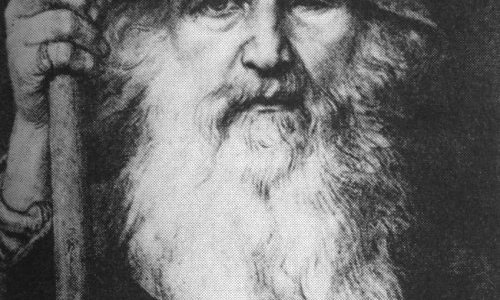
georg_von_rosen_-_oden_som_vandringsman2c_1886_28odin2c_the_wanderer29

So when I heard Gaiman was dedicating time exclusively to these fragmentary stories, lovingly shaping them into a coherent book, I immediately pre-ordered it and began my months-long wait. His dark imagination, narrative deftness, and deep understanding of the perfect, powerful cadences of storytelling are wonderfully suited to this undertaking. Gaiman is steeped in the ancient tales of humanity, and his joy is reshaping them and bringing them to us. His deep respect for myth strengthens his credentials for this project, and he succeeds beautifully.

He’s not working from whole cloth here — he is restitching stories that already exist. The problem is, they exist fragmentarily, across multiple sources. The two biggest sources are The Prose Edda and The Poetic Edda. One is (surprise) prose, the other is (surprise) ancient Norse poetry. Both come from Iceland, and there’s not much because on the one hand, people who worshipped these gods didn’t write much, and on the other hand, Christianity eradicated a lot of what they did write as pagan heresy. So Gaiman takes them, makes them his own, and makes them ready for contemporary readers to absorb easily. Why should we absorb them at all? Why is Norse mythology appealing?

The first part of the answer to that question has to do with the gods themselves, Odin especially. Next to Odin, Zeus looks like a dumb, sex-crazed jock. Odin is not just strong, he is wise, he understands the power of information, and he is wily. He works for what he has and is on a constant mission to find out more information about Ragnarok, never fully giving up on stopping it. He sacrifices himself to himself to gain the knowledge of runes, and sacrifices his eye to Mimir for a drink from the well of wisdom. These two things make Odin what he is — the wisdom to lead the gods, and the power to enforce his leadership. The runes he learns are many. One rune can blunt the weapons of his enemy, another can free him from any fetters, another can put out fire consuming a hall, yet another can calm the fire in an angry man’s breast, bringing all to a peaceful conclusion. He knows a battle rune that brings courage and strength to those who follow him to war, and another that can give life to the dead. It’s not so much that he has these powers that makes him appealing, it’s that he had to earn them. Hey Neil, show us how:

[F]or knowledge of runes, and for power, he sacrificed himself to himself.

He hung from the world-tree, Yggdrasil, hung there for nine nights. His side was pierced by the point of a spear, which wounded him gravely. The winds clutched at him, buffeted his body as it hung. Nothing did he eat for nine days or nine nights, nothing did he drink. He was alone there, in pain, the light of his life slowly going out.

He was cold, in agony, and on the point of death when his sacrifice bore dark fruit: in the ecstasy of agony, he looked down, and the runes were revealed to him. He knew them, and understood them and their power. The rope broke then, and he fell, screaming, from the tree.

Now he understood magic. Now the world was his to control.

Odin has to fight to maintain everything he has, and he knows that, in the end, no matter what he does, he will lose it all in Ragnarok. The world will end, and when it resurrects, he won’t come back with it. This grimness makes these myths meatier than their Greek or Roman counterparts: underlying every single telling of every single story of the Aesir is the certain knowledge of future death.

There’s so much more to talk about than just Odin and Ragnarok. There’s Thor, who is so extraordinarily powerful but not too smart. When wearing his belt of strength and holding Mjollnir, there is very little Thor cannot destroy, but when doing anything whatsoever requiring subtlety, such as when he pretends to be a bride in order to sneak into a giant’s house, he fails. An entire ox, seven salmon, and three casks of mead disappear under the dainty bride’s veil before the giant gets suspicious. Luckily, Thor is able to just kill him with his magic hammer. Problem solved!

There’s Skidbladnir, the huge ship that always sails under a fair wind and can be folded up like a handkerchief and put in a pocket. There’s Gungnir, Odin’s spear, upon which the gods swear unbreakable vows, and which can pierce anything and will never miss. There’s Draupnir, the gold ring that, every ninth night, drops eight perfect copies of itself, thereby increasing the wealth of its owner indefinitely.

The myths of the Aesir stand on their own, but what Gaiman does for them is consolidate them, package them in a contemporary style, and add his own spice and talent to the whole. Perhaps the best thing Gaiman does is weave them together in an accessible way, where everything is clear and tied together. I’ve read some of The Poetic Edda, and great as it is, it’s full of references to other events and incomplete descriptions of people, places, and things, because the audience for those poems absorbed those stories with their mother’s milk, and millennial skalds in Iceland didn’t write for an audience almost completely ignorant of them. Gaiman organizes a collection of the best-known stories from the beginning of the world to its end and resurrection, point A to point B, with full context.

He also modernizes the language, both of the narrator and of the gods. The book loses something in this, but it’s like what a steak burrito loses by not being steak. It doesn’t mean the burrito isn’t delicious; it just isn’t steak, and it isn’t trying to be. Take for example the following descriptions of Ragnarok, the first from Gaiman’s work, the second from the Seeress’s Prophecy.

Brothers will fight brothers, fathers will kill sons. Mothers and daughters will be set against each other. Sisters will fall in battle with sisters, and will watch their children murder each other in their turn.

Brother will fight brother and be his slayer,
sister’s sons will violate the kinship-bond;
Hard it is in the world, whoredom abounds,
axe-age, sword-age, shields are cleft asunder,
wind-age, wolf-age, before the world plunges headlong;
no man will spare another.

There’s a certain heft in the words from The Poetic Edda, but I mean, if you’re not here for the kennings, Gaiman’s interpretation is great. He finds the balance between majesty and accessibility.

He also modernizes the dialogue of the gods. In the following example, Loki has just shaved Sif’s head. Sif is Thor’s wife, and, none too happy, Thor is threatening Loki:

“No!” said Loki. “I can’t put her hair back. It doesn’t work like that.”

“Today,” mused Thor, “it will probably take me about an hour to break every bone in your body. But I bet that with practice I could get it down to about fifteen minutes. It will be interesting to find out.” He started to break his first bone.

As with the Ragnarok example, this is a trade-off. On the one hand, Gaiman brings relatability to the gods. On the other, hearing gods say something as simple as “It doesn’t work like that” somehow lessens their majesty.

The majesty of the gods might suffer when they talk like you or me, but Gaiman’s understanding of the heart of storytelling, of the cadence and pacing that creates fiction, is unparalleled and more than makes up for it:

They dug a pit and built a fire of wood in the pit, and they slaughtered an ox and buried it in the bed of hot coals, and they waited for the food to be done.

They opened the pit, but the meat was still raw and bloody.

Again they lit a fire. Again they waited. Again the meat had not even been warmed by the heat of the fire.

All that’s happening here is the gods are failing to cook beef. That’s it, but the cadence here, the sentence structure and the repetition shapes the story perfectly. Read it out loud and pay attention to how it flows. It seems so simple, but it’s flawless, and demonstrates how Gaiman is not just some guy who likes Norse myths. It’s not just his talent that’s clear; his love of the stories shines through as well. It’s hard to explain the exact effect this has on the book, but all I can say is Gaiman deeply respects and loves his subject matter, and the effort this pulls from him makes the book better.

The final question you have to ask whenever an author takes the time to rewrite stories that already exist is, was it worthwhile? Should they have done it? In this case, the answer is yes. Gaiman’s retelling is straightforward and clear. The language is polished and fitted together as only a writer with decades of practice could do it. The book walks a perfect line between faithfulness to its source material and modification for a modern audience. The only possible half-criticism that even exists for it, that the book just isn’t as majestic as the poetry, is invalid. It’s like someone who orders sushi leaving a bad review on Yelp because *gasp* it was raw fish! The book is what it is, and it’s unfair to criticize anything for not being what it was never meant to be. Besides, choosing to land on the side of accessibility might be Gaiman’s best decision here. If this book inspires some kid to be the next Neil Gaiman, it will have more than justified its existence.