Why is Lord Dunsany’s fantasy so delightful?

The progenitor of fantasy literature writes with more creativity and style than his legions of imitators

Lord Dunsany is the grandfather of modern fantasy fiction. Tolkien set the world on fire with fantasy, but he used Dunsany’s torch. The 18th Baron of Dunsany launched his literary career in 1904 with The Gods of Pegāna, in which he constructs an entire cosmogony from whole cloth — a literary first for what is now almost required for any epic fantasy. For those who want their foundational fantasy texts a bit lighter, we’re looking at “The Fortress Unvanquishable, Save for Sacnoth” today, one of Dunsany’s many short stories.

It’s one of a selection from In the Land of Time: And Other Fantasy Tales compiled by S.T. Joshi.

Books and giraffes and Dunsany
Threatening, massive dragon, pulsing bright but obscured sun, weird angel lady? Yep, it’s Dunsany!

Dunsany uses a well-worn fantasy narrative, but stuffs it with invention

The actual narrative structure of the story is exceedingly simple. Man’s village is threatened. Man attains magic sword. Man hits bad things with magic sword until bad things are gone. The framework is not much, but what Dunsany hangs on it, the sheer inventiveness and substance of the world he drapes around the cheap coat rack of the narrative is what makes him a foundational author. Let’s start with that magic sword: Leothric doesn’t just yank it out of a rock like some idiot. No, he has to fight “the dragon-crocodile who haunts the Northern marshes” and is made entirely of metal, and who has in “the midst of his back, over his spine…a narrow strip of unearthly steel. This strip of steel is Sacnoth, and it may be neither cleft nor molten, and there is nothing in the world that may avail to break it, nor even leave a scratch upon its surface.”

The hero of the story, Leothric, kills the beast and then gets the invincible sword Sacnoth by chucking the body into a furnace until the rest of the dragon-crocodile’s body melts away from it. If you know of a cooler way for a hero to get his magic sword, please comment with it.

Sword won, Leothric heads to his foeman’s castle. He enters the castle, goes from room to room, sees weird things, vanquishes weird things, and then meets with the evil wizard who is creating problems for his village. It’s not in the quality of the plot the Dunsany gets you, it’s in the depth of his world and the strangeness with which he populates it. His vision is potent, and his language delivers it undiluted to his readers.

Any nincompoop can stick a sword in a dragon. Leothric does it with style

What follows is just one example of Leothric’s trials inside The Fortress Unvanquishable:

Outside he felt the night air on his face, and found that he stood upon a narrow way between two abysses. To left and right of him, as far as he could see, the walls of the fortress ended in a profound precipice, though the roof still stretched above him; and before him lay the two abysses full of stars, for they cut their way through the whole Earth and revealed the under sky; and threading its course between them went the way, and it sloped upward and its sides were sheer.

Upon this narrow way over an endless abyss inside a castle Leothric meets and must slay the dragon Thok:

And he smote deep with Sacnoth, and Thok tumbled into the abyss, screaming, and his limbs made a whirring in the darkness as he fell, and he fell till his scream sounded no louder than a whistle and then could be heard no more. Once or twice Leothric saw a star blink for an instant and reappear again, and this momentary eclipse of a few stars was all that remained in the world of the body of Thok.

This one scene can stand in for what Dunsany accomplishes in his entire body of work. Any hero can slay a dragon, but Leothric enters a room in a castle that inexplicably contains an abyss, whose only light is that which comes from the stars on the other side of a depthless hole in the Earth. He kills the dragon, and its corpse tumbles through the endless dark, blocking starlight as it falls. The imagery is deep and rich enough to to make its reality rock-solid, and the contrast between the solidity of his description and the strangeness of what he describes is the key to the delight Dunsany manufactures in each story.
Three essential features Blade Runner 2049 inherited from the original science-fiction classic

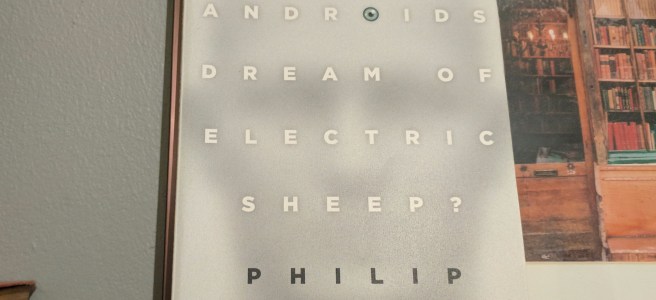
God, Philip K. Dick. You're the greatest

Visual style, an ethical dilemma, and great casting made the original Blade Runner incredible, and Denis Villeneuve built the sequel the same way

The science fiction neo-noir classic Blade Runner is the single greatest book adaptation ever made. It’s laughably divergent from its source material — it picked up Philip K. Dick’s concept of androids and that the world was screwed and didn’t run with much else. Usually, this ends poorly for everyone involved, and the result is less like Lord of the Rings and more like The Hobbit. The film worked because androids, the idea it cuts out of the book like a painting out of a gilt frame, is morally and intellectually the most interesting part, and because it filled in all the holes around that idea with a style so distinct and clear that every frame of the film is a work of art. Also, Harrison Ford’s star wattage doesn’t hurt.

The gulf between an original movie and a 35-years-late sequel is similar to the distance between a book and its movie. Blade Runner 2049 took a different direction with its source material — a direct and respectful homage to its original. The difference between it and something like The Force Awakens is that it stakes out enough of its own turf not to be an artistic failure. Hate to be a buzzkill, and I loved seeing it in theaters, but The Force Awakens was a beat-for-beat remake of A New Hope without a single new idea of its own. So, why is Blade Runner 2049 a success?

Well, before you go any further, take a gander at what you can see in theaters this weekend:

The strengths of the original Blade Runner

The success of the first Blade Runner comes down to its visuals, the stimulating central problem of replicants, and Harrison Ford. Its worldbuilding is the greatest artistic achievement of that decade, and it builds its world with visuals. Everything is gritty, wet, and cramped, either too bright or too dark, except for the Tyrell corporation building which is a soft-lit, wide temple to wealth and power. Rick Deckard’s job in the movie is “retiring” rogue replicants, androids who have begun acting anomalously. The movie spins around the moral core of killing sentient beings just because they’re acting like sentient beings, i.e. seeking freedom. Deckard never seems thrilled to be doing it, and towards the end of the film he not only falls in love with a replicant, but begins doubting whether he is one. Harrison Ford as Rick Deckard is the final style piece of the film — no one has a better put-upon-why-me face, and he’s also Harrison freaking Ford.

The movie’s plot is well-constructed, but it’s not the central component of the movie’s watchability. The action in Blade Runner is understated, almost ponderous, but what keeps the film going is that every single frame is beautiful, is art. It’s easy to watch because the literal act of viewing each frame is rewarding.

Blade Runner 2049, genetics, and inheritance

Blade Runner 2049 is definitely its father’s son. Denis Villeneuve tries to rebuild the same world Ridley Scott constructed in 1982, just adding in three more decades of we’re-screwed. There’ve been several bloody replicant revolutions and a complete ecological collapse. The first bankrupted the Tyrell Corporation (original manufacturer of replicants) and the second was solved by the agri-tech of Blade Runner 2049’s main antagonist, Niander Wallace (who bought up Tyrell’s assets and started making “safer” replicants).

Denis Villeneuve pays the same attention to visual worldbuilding as Ridley Scott did, only it’s a world 30 years more bleak. Urban areas are an industrial wasteland filled with scavengers, rust, and death, and natural spaces are an ecological wasteland filled with cracked earth, dust storms, and dead trees. People live in the middle of these extremes, in a cityscape filled with ever-advancing technology. The interplay of light and dark, the picture-perfect artistry of each frame of the movie is still there, paying perfect homage to the original.

The ethics of the sequel have shifted. Not only has the replicant-as-slave trope been made explicit, with Niander Wallace (tech magnate and the current manufacturer of replicants) stating that “[e]very civilization was built off the back of a disposable workforce” and regretting that he couldn’t breed replicants (as slaves were bred), but the main character, Ryan Gosling’s Officer K, starts the movie as an indisputable replicant, the property of the L.A.P.D. Blade Runner’s morality was ambiguous — the inventor of replicants, Eldon Tyrell, was a benevolent creator, and Rick Deckard’s attitude was “I’m killing replicants, ain’t it a shame, but hey, what else can we do?” In Blade Runner 2049, a definite replicant is struggling with issues of identity and morality. An unambiguous member of an oppressed class is at the center of the sequel, which changes the ethical landscape significantly. Not to mention Jared Leto’s amazingly creepy Niander Wallace is, unlike Eldon Tyrell, undoubtedly a Bad Guy (murder, torture, etc.).

Blade Runner 2049 has the same approach to plot as its progenitor — make it good, but don’t make it the center of the movie. The sheer beauty of the world that’s built is what makes the film. Its approach to action is a bit different — in the original, it’s a few short bursts of gunplay and chasing. In 2049, the fight scenes might be rare, but they’re definitely modern. Officer K is literally, as he was built, a killing machine, and it’s impressive to watch when he gets in a corner where the only way out is violence.

Ryan Gosling vs Harrison Ford

How cruel to put any actor up against living legend Harrison Ford, but Gosling does a really great job. Same balance of grim but emotional right underneath, same ratio of acting chops versus sheer ability to look cool. Ryan Gosling might be Harrison Ford for Millennials — good actor, attractive, with the ability to fill out an action movie without being typecast as an action star. Harrison Ford is part of what made Blade Runner great, and Ryan Gosling definitely adds style and charm to 2049. Ford is a legend, but Gosling is a worthy inheritor.

Blade Runner 2049 is the sequel every great movie deserves

Blade Runner 2049 and its predecessor are both primarily visual experiences. The plot of each is clear and strong, but the center of each film is just seeing the world it builds. Each frame, as a still photo, is interesting enough to make you want to see the next one. Preserving and intensifying the central moral quandary of the original and adding Gosling’s star power to the mix just adds more to love.

Blade Runner 2049 is heavily indebted to the original, but that’s by design. What’s important is that Villeneuve had the courage to use everything important about the original film — the stunning visual style and the central moral question of replicants — but still carve out his own original space. It might not be taught in film classes like Blade Runner is (yet), but the beauty of a director making an intellectual property his own is that one-to-one comparisons are no longer relevant. Villeneuve and Gosling made their own thing here, and it stands alone, and it stands strong.

Three Pillars That Make Nnedi Okorafor’s Binti So Incredible

Her inventiveness, her attention to emotion, and her information-dense, fast-paced style build a rock-solid science-fiction story

I have a bad habit of only finding amazing books/series/authors right as they’re about to explode into the mainstream. For example, I devoured A Song of Ice and Fire when the television show was already in production but not released. I did it again with Nnedi Okorafor. She’s been writing award-winning stories for years and years, and only a few days ago, in the midst of all the buzz about her work becoming an HBO show, did I pick up my first one, Binti.

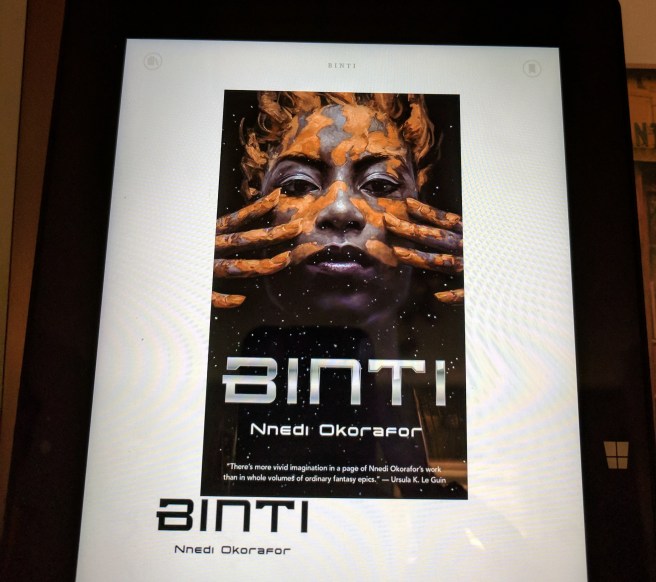
Kindle Binti novella manual picture

The first pillar is the author’s sheer creativity. This is the most inventive and fresh thing I’ve read in months. Nnedi Okorafor’s novella (the first of a set of three) is not really a happy story, but there’s a lightness and a joy in her creation, from biological interstellar ships that are basically giant star-shrimp, to the main character’s tech, based around “harmonizing,” which is a form of mathematical comprehension of the world so deep it may as well be sorcery. Binti uses harmonizing to optimize the astrolabes her family makes their living on. Astrolabes fit the same cultural niche as our smartphones but are much more powerful and beautiful. All this takes place in an afro-futurist world, where tech is extraordinarily advanced and cultural roots run deep. The conflict between the traditional expectations Binti’s family levies on her and her ambition of studying at the galaxy’s most prestigious university planet is the central emotional conceit of the novella.

The second pillar is Okorafor’s realistic attention to emotion. A general flaw of a lot of classic SFF is its treatment of emotion. It’s either overweeningly mawkish or nearly nonexistent. This is why rereads of Heinlein and Asimov just don’t grab me — the emotion that’s there is either too robotic or too overwrought. In Binti, Okorafor gives emotion its due — presents the concerns and internal torments of her characters in a clear and matter-of-fact manner — and then lets their actions as they navigate their problems do the rest of the explaining. Binti neither denies nor overfocuses on emotion. Okorafor plants the internal lives of her characters firmly, then builds the story around them without letting it get weighed down by them.

The third pillar of Binti’s greatness is the “chunk of meat” storytelling style. There’s a chunk of meat on your dinner plate that you don’t recognize. You ask what it is, but the chef shrugs her shoulders and walks away from your table. You are confused, but the presentation is interesting, and the aroma rising from it is irresistible, so you eat it, still lost but enjoying it immensely. “Oh, the main character can use math to generate an advanced meditative state, cool, great…oh ok, the ship she’s taking to university is a giant shrimp with titanium-hard skin. Cool, sure. Huh. Pass the gravy, this is delicious.” Okorafor’s chunk of meat style puts discrete and not-fully-explained pieces of the world in front of you, and the time she saves not info-dumping everything gives an immediacy to the story that carries you on a great wave, like how the Meduse…well, you’ll find out what that species does when you read the novella.

Binti is fresh and strong, from its powerfully-described world to its extremely relatable, loveable main character. Part of the freshness is its afro-futurism, and the impact of reading about an African spacefaring culture is every bit as refreshing as reading fantasy that’s not chock full of ogres and elves. It’s also a vital piece in building diversity in SFF — this triumphal entry in the field makes it a more inclusive and interesting place.

Why Octavia Butler’s Parable of the Sower is perfect Science Fiction

Butler's Science Fiction Masterpiece

She hits the big three of SF: detailed world-building, great characters, and compelling plot

Octavia Butler needs no further praise, but she definitely deserves it, so here we go. Parable of the Sower is just one present under a very well-stocked Christmas tree of literary achievement. Her oeuvre is filled throughout with characters who struggle with believable problems in relatable ways, and with powerful new ideas that are not only appealing in an oh-that’s-cool way, but because they go right to the core of how people do live, and how they should live. Butler delivers all of these gifts in a direct, conversational prose that makes opening and enjoying them a deep and simple pleasure. The only person that competes with her for simplicity and clarity of writing is Ursula K. Le Guin.

Where are we when we enter Octavia Butler’s world?

Octavia Butler's fallen California
Pretty much everywhere is this. It’s not great. Credit: TheschmallfellaCC BY-SA 3.0

The most striking accomplishment of Parable of the Sower is how believable its world is. Butler makes such small, but ultimately such significant changes to our world. The book opens in 2024, centering around a walled community 20 miles outside of Los Angeles.

The opening has all the shapes of normal life. Children doing chores. A sermon. A minister’s daughter getting baptized. Except the chores include picking fruit and vegetables from the family’s extensive home garden because store-bought food is prohibitively expensive, the sermon happens in the minister’s front room because his church, outside the neighborhood walls, was burned down, and the baptism, which takes place in a friend’s church across town, is preceded by a harrowing bike ride accompanied by armed adults through burned-out streets strewn with the starving and desperate. These details are ubiquitous — the forms of normal life linked with the changes that have already taken place, and those that are coming. Another couple of details: five kids are getting baptized together because all of their families went in together to share the debilitating expense of the gallons of potable water necessary for the ritual, and almost everyone works from home with weekly or monthly in-person check-ins because a daily commute is just too dangerous.

I could keep listing these for another ten pages, but I’m not Octavia Butler, so it would be extremely boring. Butler weaves all of these in so inseparably from the narrative impulsion of the story that each individual one passes notice, but their collective impact builds a world that seems kind of normal but is in constant flux and danger. Any of the trappings of normalcy are willfully imposed by the older generation. The protagonist lives in a gated community, completely normal! The tops of its walls are covered in crushed glass, and the keys to the front gate are jealously guarded by the heads of household. Oh…

Characters are at the center of any good fiction

The key to Octavia Butler’s work is her understanding of how people actually function, how they are. All writers, when they construct characters, are building facsimiles that readers are willing to accept if they’re done well enough. There’s no way to actually capture everything people are in a handful of words, but Butler comes close.

Lauren Oya Olamina, the protagonist, is a young black girl, old enough to have some responsibility in the world, but young enough not to view responsibility as clinging to the structures of a dying past. Her father is a powerful presence, the neighborhood minister, a sensibly-acting and deep-thinking man who is the main personality actually holding the community together. The central conflict of the early book, aside from survival, is the clash between this strong-willed daughter and her stubborn father. They love each other deeply, but see the world in fundamentally different ways:

“Do you think our world is coming to an end?” Dad asked, and with no warning at all, I almost started crying. I had all I could do to hold it back. What I thought was, “No, I think your world is coming to an end, and maybe you with it.” That was terrible. I hadn’t thought about it in such a personal way before. I turned and looked out the window until I felt calmer.

Butler is so good at people. They can fight and yell and disagree and love each other deeply. Lauren is in the midst of a big fight with her dad, and almost loses control and cries because she contemplates the death of the person being so antagonistic to her.

The most rewarding part of the early book is this relationship: strong, intelligent Lauren Olamina clashing with the man who raised her to be strong and intelligent. She recognizes her debt to him even as she hopes for an escape from his strictures:

I love him. He’s the best person I know, and I care what he thinks. I wish I didn’t, but I do.

Earthseed: the world’s going to hell, why not start a new religion?

Olamina's religion journal
This is all Lauren Oya Olamina needed to begin her own religion. What have you done lately?

As Lauren navigates this conflict, she logs everything in her journal. In fact, that’s the book. The Parable of the Sower is a series of Lauren’s journal entries, sometimes with a day between them, sometimes a month. The confessional style matches well with Butler’s vivid and conversational prose — the accessibility of the writing mixes with the emotional immediacy of the journal to cook a completely satisfying, easy-to-consume meal. As easy and fun to eat as McDonald’s, as nutritious as a kale salad. Another key function of the journal is it’s where Lauren starts building her new religion — Earthseed. Again, the entire world of the book is built on the linking of the completely normal (teenage girl journaling) with the new and strange (she’s journaling about her homegrown religion). Here’s verses 1 and 3 of Earthseed: The Books of the Living, Olamina’s religious text:

All that you touch
You Change.

All that you Change
Changes you.

The only lasting truth
Is Change.

God
Is Change.

———————-

We do not worship God.
We perceive and attend God.
We learn from God.
With forethought and work,
We shape God.
In the end, we yield to God.
We adapt and endure,
For we are Earthseed
And God is Change.

This is what drives Lauren through the story. God is change, and it’s humanity’s job to shape God, to accept, anticipate and influence change. It weaves over and around all that happens in the story: Lauren’s acceptance of and attempted control of change, from growing up in a civilized island in a sea of lawlessness, to surviving the fall of her neighborhood (sorry for the spoiler, but it’s pretty clear from the get-go that this has to happen), to traveling coastal California attempting to find a better life. God is Change.

The Big Three of Science Fiction

The Parable of the Sower is everything that’s great in SF. All the science fiction I love shares three traits: well-built characters, a detailed world, and narrative impulsion. Without believable, relatable characters, what is there to care about (ahem, Asimov)? Without a detailed exploration of the world, how the world came about, the anthropology of the society, then the otherworldiness of the SF is just a gimmick. And without narrative impulsion, where each page gives you a reason to turn to the next one, what you have is a boring book. The characters and world of Butler are built with a loving attentiveness to detail, and once you care about the characters and how they move through the world, that’s half the narrative impulsion right there. What provides the rest is the suspense Butler creates in describing Lauren moving through increasing danger towards her goal: is she going to get there? Oh no that was close! I have to find out! Octavia Butler is a champion, and reading her is a privilege.